











































By Stanley Gazemba
On 30 April, 2014 the benga fraternity and lovers of music woke up to the shocking news of the death of Ochieng Nelly Orwa, a virtuoso of the benga guitar and a master composer who was among the pioneers of modern benga music in the formative and adventurous 60s. One of the founders of the Ogara Boys band, Ochieng, alongside John Ogara Odondi ‘Kaisa’ and Samuel Oketch Oyosi ‘Jabuya’ were among the first crop of musicians who took traditional Luo music and adapted it to a modern style that incorporated the guitar, a novel instrument at the time.
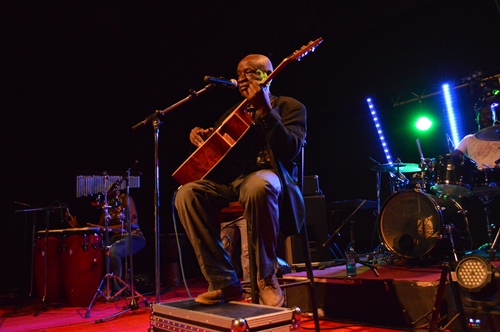
Ochieng’s death was especially shocking because it came at a time when he had been making a successful comeback to the live music scene after a long break. According to Tabu Osusa, the Executive Director of Ketebul Music, Ochieng had secured tight bookings both locally and abroad through to 2015. He was set to do a major tour of Europe that would see him perform in Germany, Holland and Belgium. But even more immediate, he was set to perform at the DOADOA Festival in Jinja, Uganda the following week. His slot was taken up by Dola Kabarry.
He had also been shortlisted as one of the Kenyan musicians to showcase authentic Kenyan music at the Smithsonian Folklife Festival in the US. The Folklife Festival showcases one country every year, and 2014 was Kenya’s turn.
According to Osusa, they were relying on Ochieng, as the most experienced musician in the troupe, to offer guidance to the younger musicians. “It is very sad,” he said simply, crestfallen. “Ochieng’s death came at the wrong time.”
In 2013 Ochieng made a number of recordings with Radio France International, and he had been invited to perform in France later in 2014. These are just some of his slated tours that had to be cancelled.
Ochieng was a versatile and jocular musician who enjoyed rapport with the younger musicians he worked with, often trading banter whenever they were not in the studio recording. He was adventurous too because he could work with practically anyone, including rappers. One of his recent projects involved a collaboration with the rap duo of MC Matre from the US and Paleface from Finland, who had done a studio recording with him, and which they were set to release. The joke at the studio was that he should start donning bling and practicing walking with a rapper’s swagger. Unknown to him at the time, he wouldn’t live to see the project come to fruition.
Ochieng was keen on working with younger benga and rumba musicians with the intention of passing on his guitar-playing and composition skills to them – a rare thing among musicians of his generation, who often passed on with their skill.
He was born Nelson Ochieng in Rachuonyo District, Oyugis in Nyanza in 1942. His first instrument was the orutu, which he learnt to play in Class 3, before graduating to the guitar.
Although he later became a master of the benga style, Ochieng initially started off playing rumba in 1961, appearing as a solo artist, before joining Ogara the following year. On stage Ogara played the bass, Samuel Oketch Oyosi the lead guitar and Ochieng the rhythm guitar, with all three collaborating on the vocals. According to Ochieng, it is then that they started playing benga, which had been variously called meringue by the Congolese, or samba by the South Americans; all of which are on the same tempo.
Ochieng traced the root of the word ‘benga’ to a gig they landed in Uganda on invitation by the Luos living there. There was a certain dress that was in fashion with the ladies then- the ‘ogara’ style- which fit loosely. When the women danced to the new benga music they felt themselves ‘loosen up’- obengore, in Luo- which lent the genre its name. It is a contentious issue, but Nelly believed that was how benga came to be.
On returning home, a businessman known as Ongong’a Sega offered to buy Nelly instruments so he could form his own band. He thus separated with Ogara and formed the OS Fiesta Band in 1965. But it lasted only two years before Nelly left to join the resident band of the Friends Paradise Club, now called Bottoms Up Club in Kisumu, on invitation of the owners who craved his benga repertoire, together with covers of Elvis Presley and Cliff Richard that were in vogue, and which Nelly could play.
In 1968, he acquired his own equipment and started playing freelance. He toured Uganda briefly with a Congolese band but it was short-lived due to language differences and homesickness. In 1970 he joined the Bongo Boys, with whom he played for a while before quitting music for ten years.
It is this ten-year absence that another ‘Ochieng Nelly’- real name Joseph Nyakech from Kabondo- and who has since passed on, came in to fill, creating confusion on who was the real ‘Ochieng Nelly’. The other Nelly, whose full stage name was Ochieng Nelly Mengo, was apparently a protégé of the older musician, having learnt to play the guitar from George Ramogi, who was a student of the older Nelly. Ochieng Nelly Mengo and Collela Mazee made a potent team, and they were very popular.
In 1980 Nelly made a comeback in live music playing alongside his wife, Jane Auma, who he had taught to play. They performed as Rachuonyo Jazz Band.
Nelly had toured extensively in his music career, but in an earlier interview, he cited playing for Nelson Mandela at Windsor Hotel during his tour of Kenya as one of his finest hours. Before his death he was signed to Ketebul Music label, where he had been working on both new and reworked songs. Among the many talented young musicians Ochieng was working with were Jared Okoth Ndede, better known as ‘Akuku Danger’, Shiphton Winyo and jazz guitarist Eddie Grey.
He succumbed at Kenyatta National Hospital where he was rushed upon collapsing by his family and friends.


Most popular

Top amapiano songs of 2026
16 Feb 2026

Top Naija songs of 2026
31 Mar 2026

Call for applications: ACCES 2026 Emerging Artist Spotlight Competition
01 Oct 2026

Top Afrobeats songs of 2026
19 Mar 2026
AFRIMA 2026: All the winners
12 Jan 2026
Plea for support: Zim music studio damaged by hailstorm
07 Oct 2026
Disclaimer: Music In Africa provides a platform for musicians and contributors to embed music and videos solely for promotional purposes. If any track or video embedded on this platform violates any copyrights please inform us immediately and we will take it down. Please read our Terms of Use for more.

Subscribe to our monthly Newsletter
Follow us on social media


Please log in to post a comment.