












22 avr 2026
L’essor de l’intelligence artificielle dans la musique franchit un nouveau cap. La plateforme...

The University of the Witwatersrand (Wits), through its Wits Innovation Centre (WIC) and the Machine Intelligence and Neural Discovery Institute (MIND), hosted an artificial intelligence and music showcase on 16 April 2026 at its Johannesburg campus. The event examined the growing intersection between AI systems and African musical creativity.
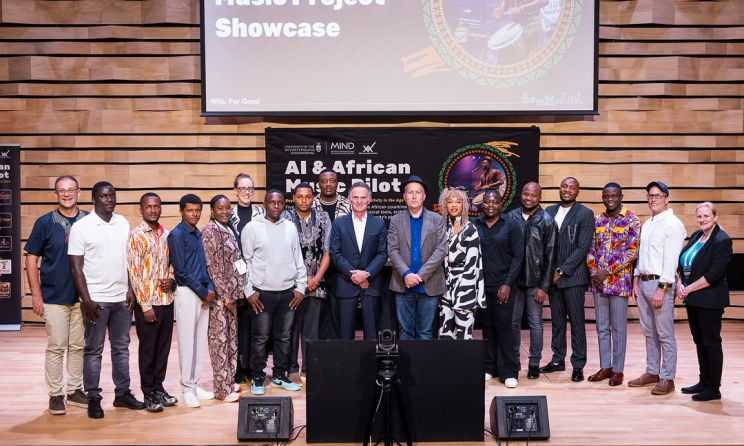
The initiative brought together five teams of musicians and technologists drawn from across the continent, including South Africa, Ghana, Cameroon, Kenya and Ethiopia. Each group paired an artist with an AI specialist and spent several months developing tools designed to engage with African sound in a culturally grounded way. Their work was presented to a live audience through demonstrations and discussions.
The first presentation, led by Joshua Kroon and Emmanuel Apetsi, introduced the Bebii Engine, an AI-driven music generation system aimed at preserving indigenous knowledge through sound. Their demonstration included a live performance of a traditional African composition using indigenous instruments, while the system processed and adapted the material in real time.
Another project, Timah.AI, developed by Tora Nyamosi and Lawrence Moruye, focused on preservation through digitisation. The web-based platform allows users to upload recordings of traditional music, which are then transcribed and stored in a searchable digital archive intended to support access to African musical heritage.
Linda Nyabundi and Gebregziabihier Niguise presented Heritage in Code, a response to the limited presence of African music datasets on mainstream AI platforms. The project centres on building structured datasets enriched with metadata and cultural context, aimed at improving how AI systems recognise and generate African musical forms.
One of the most widely received presentations came from South African artist Umlilo and Ghanaian engineer Gideon Gyimah, who developed Zazi, an AI-powered co-creation tool designed for musicians. The system includes features such as stem isolation, voice cloning, track merging and AI-assisted mastering, with a particular focus on African languages and tonal systems. During a live demonstration, the platform generated a maskandi-inspired track with isiZulu vocal elements, responding to multilingual prompts in real time.
The final project, Bina.AI, developed by Ehinome Ogbeide and Ashuza Muhigiri, focused on early childhood learning. The platform generates personalised songs and stories for children, designed to be culturally relevant and educational, with African contexts embedded in its content.
The programme also included a keynote address titled Generative AI and Music: The State of Play, alongside a roundtable discussion on Creative Sovereignty in African Music and AI, featuring industry professionals and researchers.
Taken together, the presentations highlighted both the creative potential and the practical challenges of integrating artificial intelligence into African music ecosystems. While the technologies on display varied in scope, they shared a common emphasis on cultural preservation, accessibility and innovation.
Below is a livestream of the showcase:
Sponsored
Take this space






Commentaires
s'identifier or register to post comments