













28 avr 2020

Sensibiliser les populations aux bonnes pratiques contre le coronavirus qui sévit en ce moment, est...

On a dusty field, chants rise before Robert Kyagulanyi Ssentamu, widely known as Bobi Wine, steps forward. The crowd is youthful, but not exclusively young. Young people press closest to the front, while children, middle-aged workers and older supporters gather behind them, drawn together across generations. The scene recalls Bobi Wine’s ‘Uganda Zukuka’ (Uganda, wake up), not because the song is playing, but because the crowd itself embodies its message, with young and old standing together. The energy carries the cadence of performance, yet the gathering is unmistakably political, occupying a space where music, memory and political expectation overlap.
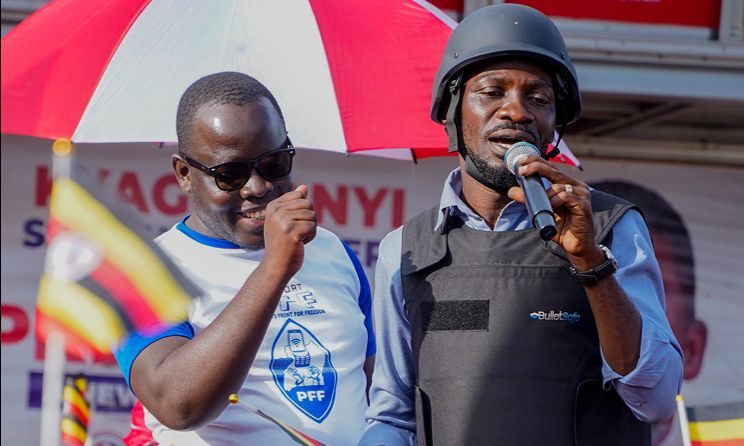
Scenes like this have become familiar across Uganda, revealing something deeper than electoral mobilisation. They demonstrate how cultural expression has become a primary language of political belonging in a society where formal institutions have struggled to absorb the aspirations of a rapidly growing youth population. Bobi Wine’s public appeal cannot be understood through party structures or policy promises alone. It has been shaped through music, lived experience and a shared sense of exclusion articulated long before he entered formal politics.
The central question raised by his trajectory is not whether an artist can become president. It is how art itself becomes political in contexts where access, dignity and voice are unevenly distributed. Bobi Wine’s rise offers a lens through which to examine a wider cultural landscape in which musicians and audiences are renegotiating the boundaries between expression, participation and power.
Music before office
Bobi Wine’s political imagination was shaped in Kamwokya, a Kampala neighbourhood defined by economic pressure and social improvisation. His early music engaged directly with everyday realities, often reflecting concerns circulating in public conversation but rarely addressed with seriousness by political leaders.
In ‘Ebibuuzo’, released in the mid-2000s, he raised questions about corruption, unresolved violence, rising living costs and public tragedies that had become routine. The song did not prescribe solutions. It asked why accountability remained elusive and why citizens were expected to endure without explanation. Its power lay in recognition rather than instruction.
Later songs, such as ‘Tugambire Ku Jennifer’, responded to the treatment of street vendors and unemployed youth in Kampala, criticising heavy-handed city enforcement and social exclusion. These were not campaign songs. They were cultural commentary, grounded in observation and lived experience. Long before Bobi Wine sought public office, his music had already begun to function as a form of civic reflection.
By the time he was elected to Parliament in 2017 as the Member of Parliament for Kyadondo East, his political language was already familiar. For many young Ugandans, his move into politics did not feel like a contradiction. It felt like continuity, because the concerns that defined his music had long articulated a critique of governance, dignity and representation.
As his audience expanded, his work evolved. Songs such as ‘Freedom’ and ‘Ogenda’ reflected a growing civic awareness. They did not call for upheaval, but for recognition. Performances increasingly became spaces of collective reflection, where music and political consciousness intersected. Over time, the boundary between cultural participation and political engagement grew increasingly thin.
From cultural authority to political threat
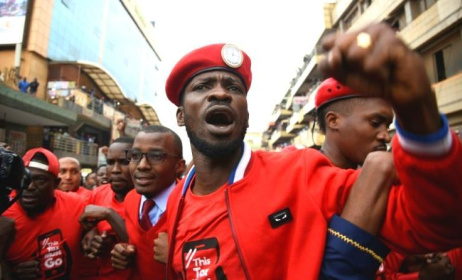
As Bobi Wine’s influence grew, the state’s response shifted. Concerts were cancelled, performances restricted and cultural symbols associated with his movement reframed as security concerns. The red beret adopted by his supporters was classified as military attire.
Across Africa, music has long unsettled authority, not only because of what it says, but because of its capacity to gather people outside formal political channels. In Uganda, the concern was not lyrical content alone. It was mobilisation.
The turning point came during the Arua by-election in 2018, when Bobi Wine was arrested and beaten. His driver, Yasin Kawuma, was shot dead. These events reshaped public perception. He was no longer viewed merely as an artist testing political space, but as a direct challenger to state power.
The 2021 presidential elections intensified this dynamic. Campaigns unfolded under heavy security. Bobi Wine wore protective gear while addressing rallies. His home was surrounded during vote tallying. Supporters reported arrests, abductions and intimidation, while an internet shutdown limited public scrutiny. Civic space appeared increasingly militarised.
Culture, economy, and political choice
These tensions cannot be separated from Uganda’s economic realities. The country has one of the youngest populations globally, with a median age of around seventeen. Youth unemployment and underemployment remain widespread, while public debt has expanded, constraining investment in education, health, innovation and culture.
Inflation between 2022 and 2023 eroded household purchasing power, particularly through food and fuel prices. Although headline inflation eased in 2024 and into 2025, the effects of earlier increases continue to shape daily life. A significant proportion of Ugandans still live at or near poverty thresholds.
In this context, politics becomes personal. For many young people, participation is no longer abstract. It is directly linked to survival, dignity and economic opportunity. Bobi Wine’s emphasis on accountability, economic inclusion and generational representation resonates not because it is novel, but because it reflects lived conditions that had already been expressed culturally for years.
His manifesto, developed through the National Unity Platform, offers one reading of Uganda’s present moment. It frames the country as constrained by governance challenges and calls for change, accountability and the restoration of civic dignity, particularly for young people and those whose everyday experiences rarely shape public decision-making. President Yoweri Museveni’s National Resistance Movement manifesto offers a different reading, emphasising progress achieved under long-term leadership and presenting continuity and stability as essential to safeguarding those gains. The contrast is less about personalities than about interpretation. One approach begins from lived experience and unmet expectations; the other from institutional continuity and accumulated authority.
Artists, risk, and public alignment
As Uganda approaches the presidential election scheduled for January 2026, political tensions have intensified. Reports of violence against opposition supporters, including incidents involving Bobi Wine and his campaign teams, have raised concern among legal bodies and international observers. At the same time, Bobi Wine has consistently urged supporters to remain peaceful, framing participation as observation, documentation and presence rather than confrontation.
In recent weeks, reports have circulated of Bobi Wine being blocked from campaign routes, dispersed with tear gas and repeatedly confronted by security forces during public appearances. Video footage shared online shows him addressing police directly, repeating phrases such as “I am not resisting,” “I have not done anything wrong,” and “allow me to continue” as he attempts to proceed with campaign activities. These moments are not merely campaign incidents. They reflect an ongoing tension over who is permitted to move freely, assemble publicly and participate openly in civic life, particularly when visibility and large audiences are treated as risks rather than ordinary features of democratic engagement.
Taken together, these repeated phrases operate as assertions of procedural fairness, signalling an expectation that lawful presence, peaceful conduct and participation in public life should not require exceptional permission.
This moment also builds on a longer opposition history. For decades, Dr Kizza Besigye challenged entrenched power at high personal cost, helping to normalise dissent in a political environment shaped by fear and repression. What followed was a different form of mobilisation, driven less by formal political structures and more by culture. Through music, Bobi Wine translated political criticism into stories and expressions drawn from everyday life, making them familiar to people who had never engaged with formal opposition politics. While Besigye has stepped back from electoral competition, the political space he helped open continues to shape contemporary engagement.
Across the region, artists face similar choices. In Uganda, some musicians openly align with the ruling party, composing campaign songs and appearing at political events. These alignments are widely understood as paid engagements, reflecting the economic precarity of the creative sector, where state patronage can offer rare stability.
Audience response, however, is changing. In Tanzania, recent political unrest prompted backlash against prominent artists perceived as silent or aligned with power. Property damage and organised boycotts affected live performances and social media followings, signalling a shift in how cultural legitimacy is negotiated. Fans increasingly treat trust as a form of currency.
Alongside these visible dynamics, quieter forms of artistic engagement persist. Tanzanian musician and activist Vitali Maembe has, for over two decades, used music to address governance and constitutional reform without positioning himself as a political actor. His work has faced restrictions and cancellations, illustrating how even reflective civic engagement can attract pressure.
In The Gambia, rapper and activist Killa Ace has similarly engaged political themes over time, from opposition to authoritarian rule to contemporary economic justice issues. His recent arrest during protests against high internet data costs demonstrates how artists remain exposed to risk even after political transitions.
Together, these cases point to a broader pattern. Artists who engage public life face reputational, economic and personal vulnerability, often without institutional protection. Legal, financial and psychosocial support mechanisms remain weak. The gap between cultural risk and institutional response exposes the fragility of systems meant to protect creative voices.
What Music Leaves Behind
As Bobi Wine campaigns across Uganda, the language of music continues to shape how politics is understood and practised. Long before manifestos, rallies or voting instructions, songs created a shared vocabulary of frustration, dignity and belonging. That cultural groundwork has already altered how many young Ugandans understand their place in civic participation.
Uganda’s moment reflects a wider continental pattern. Across Africa, artists have often shaped political imagination before institutions respond. Political change may arrive slowly, but shifts in consciousness tend to endure. Once people recognise themselves as participants rather than spectators, public expectations rarely return to earlier limits.
It is in this sense that quieter songs such as King Saha’s ‘Ensi Yaffe’ matter. The song returns to the idea that the country belongs to its people. In the present moment, that idea has acquired practical meaning. As state authorities warn against disorder and opposition figures urge peaceful vigilance, responsibility is increasingly framed not as protest, but as presence, attentiveness and respect for public process.
That is what music leaves behind. Not a slogan or a single political outcome, but a shared understanding of belonging and collective civic duty. If a country belongs to its people, what responsibilities does that ownership now demand of them?
Lucy Ilado is a cultural development practitioner based in Nairobi, Kenya. She works at the intersection of media, research, and policy advocacy within the cultural and creative industries. The opinions and views expressed herein are solely her own and do not reflect the position or stance of the publication.
Sponsored
Take this space



Commentaires
s'identifier or register to post comments