


The structural challenge facing African culture

Across Africa, cultural visibility is no longer a marginal phenomenon. This shift has not resulted from a sudden awakening or a single breakthrough, but from the speed and reach with which music, film and live digital culture now circulate. Music crosses borders almost instantly, films travel more easily beyond their countries of origin, and audiences gather around live digital moments in ways that increasingly resemble the shared rituals of concerts, cinemas and festivals. Together, these dynamics are forming a continental public that is neither passive nor peripheral.
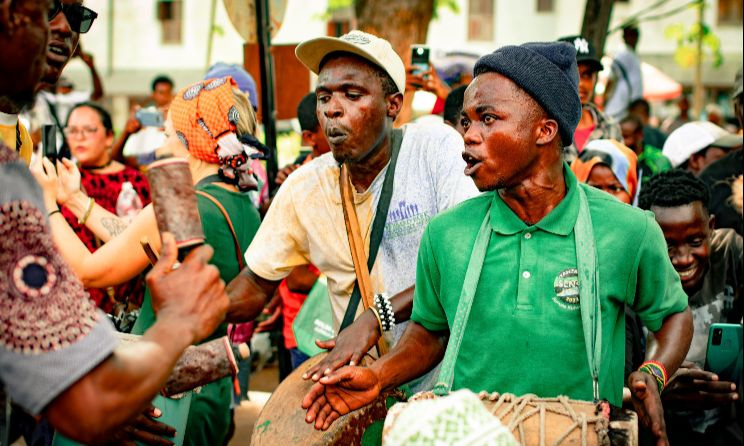 An informal performance attracts a crowd at the 2025 Sauti za Busara Festival in Zanzibar. Photo: Sauti za Busara Festival
This collective intensity was particularly evident during the recent African tour of streamer iShowSpeed, whose live broadcasts attracted hundreds of thousands of concurrent viewers across several cities. The significance of the moment lay less in the individual behind the camera than in the behaviour it revealed. Audiences followed events in real time, gathered physically around the stream, and amplified it rapidly across platforms. What appeared to be a digital spectacle was, in fact, a familiar cultural pattern playing out on a global platform.
Yet for many musicians, filmmakers, managers and cultural workers, this visibility often feels hollow. Streams increase, crowds gather and clips circulate globally, but touring routes remain fragile, royalties arrive inconsistently, and projects struggle to move from momentum to continuity. What appears externally as success often feels internally like instability.
This tension now defines much of Africa’s contemporary cultural economy. The challenge is not a lack of talent, creativity or audience appetite. It is an organisational problem. Attention exists at scale, but the systems needed to convert that attention into durable industries remain uneven, fragmented or absent.
In short, Africa does not lack audiences; it lacks the structures that allow attention to mature into stability.
Culture as productive infrastructure
In markets that endure, culture is treated not only as expression or identity, but as productive infrastructure. Music and film operate as labour systems, market systems and institutional systems that require continuity over time. Value emerges not from isolated moments of success, but from sustained interaction between creation, circulation, rights management and reinvestment.
This distinction is crucial in African contexts. Where cultural activity is treated mainly as a series of one-off events or short-term promotional moments, success flares briefly and fades. Where it is treated as infrastructure, it accumulates. Infrastructure in this sense extends beyond studios or equipment. It includes touring routes that enable regular performance, screening and broadcast pathways that keep films circulating beyond their premieres, rights systems that ensure creators are paid, commissioning structures that reduce risk before visibility peaks, and data systems that make economic activity legible.
The key question, therefore, is not whether African culture travels globally. It clearly does. The more difficult question is whether domestic systems are strong enough to retain value when that work crosses borders.
Continental frameworks already recognise culture as a driver of development, employment and integration. The African Union’s Plan of Action for the Cultural and Creative Industries calls for stronger value chains, sustainable markets and decent work for creators. The Charter for African Cultural Renaissance goes further, placing culture at the centre of economic transformation and sovereignty over creative resources. The challenge lies not in articulation, but in implementation.
Ecosystems, not isolated sectors
African creatives rarely experience the cultural economy as a set of discrete sectors. In practice, it functions as an ecosystem. Music feeds film through soundtracks and scores. Music videos shape visual language. Live performance drives digital discovery. Festivals operate simultaneously as performance spaces, screening venues, networking hubs and market entry points. Audiences move fluidly between audio, video, live events and online platforms, often within the same cultural moment.
Policy and investment, however, do not always reflect this reality. Music, film, broadcasting, live performance and digital content are still treated as separate domains, governed by different ministries, regulations and funding mechanisms. The result is a persistent gap. Artists, venues, festivals, platforms, rights bodies, funders and audiences interact daily, but rarely through shared calendars, common standards or linked markets. Activity is high, yet long-term value remains difficult to build. The ecosystem exists in practice, but not in structure.
This pattern is visible across the continent. In Kenya, music videos and live sessions perform strongly online, while live performance income remains unpredictable and poorly documented. In South Africa, stronger venues and rights systems have enabled more stable revenue streams, though access remains uneven. In Nigeria, regular circulation across film, television, music and digital platforms allowed domestic markets to grow before global export became viable.
In Francophone West Africa, shared language markets have enabled regional circulation. In Côte d’Ivoire, music and audiovisual works move easily across borders through broadcasters, festivals and digital channels. In Mali, strong cultural identity and live performance traditions sustain demand, yet limited touring infrastructure and weak rights collection continue to restrict income. North Africa presents another variation, where established broadcast systems support circulation even as independent creators struggle for access.
These differences are not about talent; they are about how systems are organised. When systems align, outcomes improve.
Why visibility rarely becomes livelihood
When popularity fails to translate into income, it is rarely accidental. Across much of Africa, music and film reach audiences primarily through global platforms designed for scale and advertising efficiency, rather than for nurturing local markets. While these platforms expand reach, they do little to build touring circuits, sustain commissioning pipelines, formalise live economies or strengthen rights enforcement at national level.
As a result, attention grows faster than earnings. Streams and views increase, while income remains uncertain. Live events attract crowds without consistent fees or reliable reporting. Films premiere and then disappear without sustained distribution pathways. Creative output flourishes, but economic returns dissipate.
Royalty data reflects this imbalance. Public performance and audio-visual rights across much of the continent are collected far below their potential, not because activity is lacking, but because it remains informal, under-measured and weakly enforced.
For creatives, this contradiction is a daily reality. Venues fill, livelihoods remain fragile. Viral moments circulate widely, yet often lead nowhere. Success feels close, but proves difficult to sustain.
Markets are built, not rescued
If visibility alone were sufficient, Africa’s music and film sectors would already be among the most stable globally. The persistent gap between attention and livelihood points to deeper structural issues.
Markets that endure do not emerge by chance, nor do they stabilise through momentum alone. They are built deliberately, through planning, coordination and sustained institutional commitment, often long before success becomes visible. Across much of Africa, cultural policy remains reactive, with support arriving after a hit, a crisis or a surge of attention rather than beforehand.
Building markets requires a shift from projects to pathways: circulation before export, commissioning before hype, and rights systems before scale. It means investing early in touring routes, screening networks, venues and licensing systems so that creators are not carrying disproportionate risk.
Where this approach has been applied, even imperfectly, results are evident. Nigeria’s music and film industries grew through consistent engagement with domestic audiences. Francophone markets leveraged shared language, regional broadcasters and cross-border funding to overcome limitations of national scale. The issue is not perfection, but intention.
What functioning systems look like
Effective cultural systems are recognisable. Artists tour regularly. Festivals connect rather than operate in isolation, supported by coordinated calendars that enable movement across cities and borders. Data is recorded rather than assumed.
When ticket sales, attendance figures, broadcasts and royalties are tracked accurately, financial institutions gain confidence. Risk becomes measurable, and investment becomes possible. Without data, culture remains difficult to finance, regardless of popularity.
Leadership is equally important. In many countries, arts and culture portfolios are treated as political appointments rather than technical responsibilities. When leadership lacks sector knowledge, policy becomes symbolic and short-lived. Informed leadership, by contrast, can align culture with economic planning, tourism, education and trade.
Institutional design also matters. Countries with dedicated cultural agencies are better positioned to implement policy, collect data and coordinate markets. Where culture is embedded loosely within broad ministries, it competes with other priorities and often loses visibility.
Rights regulation is critical. Most collective management organisations in Africa are private, and effective regulation must protect creators without undermining collection systems. Kenya offers a cautionary example, where prolonged conflict between regulators and CMOs weakened collections and eroded trust, leaving artists worse off. When regulation becomes adversarial rather than enabling, creatives bear the cost.
When these elements work together, growth compounds. When they do not, success depends largely on chance.
Africa’s cultural future will not be determined by visibility alone. Audiences are already present, listening, watching, sharing and participating at scale. The responsibility now lies with governments, regional institutions and market actors to build systems that allow cultural work to endure, rather than merely appear.
Lucy Ilado is a cultural development practitioner based in Nairobi, Kenya. She works at the intersection of media, research, and policy advocacy within the cultural and creative industries. The opinions and views expressed herein are solely her own and do not reflect the position or stance of the publication.
Articles populaires






Sponsored
Take this space




Commentaires
s'identifier or register to post comments