

























































Traditional Togolese music forms part of initiation rites and festive ceremonies through various songs, instruments, and dances which reflect the values, real-life experiences, and practices of various ethnic groups.
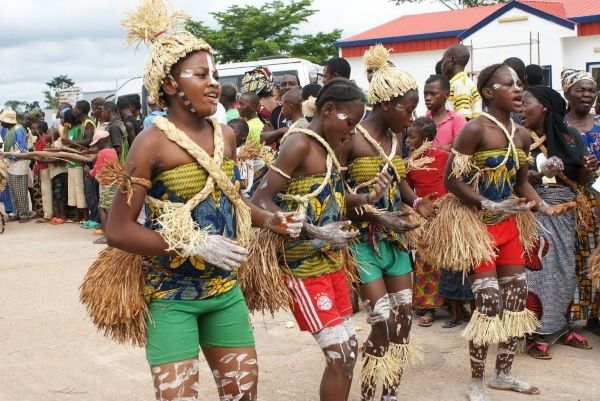
Music to Celebrate
The people of northern Togo are considered warriors. Their music draws its origins from initiation rites which mark the rites of passage within the community. Music is essentially dedicated to celebrating the bravery and strength of the initiated, or to praise the purity and honor young girls. For example, the Kabyès sing the YoÐougliya composed by griots during the Evala Kondonna (initiation rite for young boys) or Akpema (initiation rite for girls).
Anyone can compose music. Even though most griots are not historically recognized as artists, some of them, like the griot of Pagouda, made an impact onTogolese music and exported their music beyond its borders. Most of the songs can be executed and danced by the whole community during initiation rites, while others are exclusively reserved for a category of people or for a special occasion.
For instance, the Bassar's dance of fire called tibol (or t'bol) is a ritual dance where the initiated achieves a capacity for divination. The initiated dances barefoot across hot coals in front of the most important members of his clan.
The dance takes place between 11pm and 6am and only a versed singer can hum melodies while being accompanied by musicians. The singer hums, asserting his power while challenging his enemies to attack him spiritually. If the singer is not spiritually strong he can lose his voice.
The Kabyè people only dance during the habiês ceremony, (dance demonstrating spiritual power). The link between dance and music is such that some traditional music styles were named after the tchimou ( a dance performed by a girl old enough to get married) and kamou (dance after the November harvests).
Music in the north celebrates bravery, while in the South, music serves to release frustrations or resolve conflicts.
It is common with the Ewe and Guins of Togo to resolve conflicts between two families or clans by singing. The griots from both clans compose their songs inspired by the opposing clan's past mistakes. The song is then performed at a ceremony where both clans sing. The songs can become popular songs across generations.
The songs of the Ouatchi people are also based on personal experiences or anecdotes. Music becomes a means to pass on history, events and real-life experiences of a community.
The Pleureuses de Klomayondi is a group of singers who tell the story of their community, from the period of slavery, colonization to independence through their songs.
People from the south of Togo play music to thank their ancestors for a joyous event or during a burial ceremony. There are dozens of rhythms. The most famous of which are Agbadja, Gazo, Gbekonand Akpesse; all accompanied by specific dance steps. These steps demand flexibility and agility and are performed in a group.
The tawugan dance of the Ouatchi people is exclusively performed by the eldest son after the death of his father. He carries a 60kg drum on his head from his father's house to the public square. He then dances to honor the life of his father.
Some artists have managed to merge traditional and modern music. For example, King Mensah, whose songs are inspired by the gazo, agbadja or kamou, earned him the award for Best Traditional Artist of West Africa at the 2004 Kora Awards and several other distinctions.
Traditional-Modern Music in Togo
The singer Wilfried A2 was born in the northern part of Togo where he was inspired by the tchimou and kamou rhythms. However, the strongest influence of traditional music on urban music can be seen from 2010 with the rise of young artists like Kossi Ape' Son (ex-dancer for King Mensah), Mic Flammez and Amen Viana.
King Mensah launched the ‘Akpê Gwetta’and ‘Gazo Cool Catché’, a mix of urban Gwetta, Cool Catché created by Toofan, traditional rhythms (originating from the centre of the Togo) and Gazo. Mic Flammez chose the kamou and chimo rhythms to give another dimension to his rap, while Amen Viana tried to give a touch of rock to famous traditional Togolese songs.
Traditional music instruments in Togo
Several accessories and percussion instruments are used in traditional Togolese music. Although varying from one region to another, these instruments are for the most part made of wood, metal, animal skins (doe or antelope) and animal horns.
The drum (Evù), castanets (Akayê) and the gong (Gàkongoé) are essential to traditional music in the south of Togo. Their music is also accompanied by hand clapping. Five kinds of drums of different sizes are used. They are in the form of a hollow trunk, oval shaped with two holes of which only one is covered by animal skin. Timbre or sound variations depend on the size of the drum and the stretching of the skin.
The atsimevù (between 1,2 m and 1,6m) is the largest of these drums and its sound leads the orchestra by imposing the pace and tempo. This large instrument is placed on a piece of wood in the form of an X (vudetsi) for support and the player must stand parallel to the instrument. It can be played with bare hands or with two wooden sticks according to the desired sound. It is often accompanied by other smaller drums such as the kplikpan, atsihui and kadam (the smallest).
These instruments and accessories are more diversified in the north of the country where flutes are also used, in addition, to drums. The olikpo (flute) is made of animal horn or mil stems between 15 and 30cm long. The dégândrê (horn) is made of ivory in which the liquid of the mil stem is poured to moisten and guarantee a tone. Metal bells are also used.
The drums of the north are smaller, generally cylindrical, equipped with shoulder straps placed under the armpit or over the shoulder. A stick in the shape of a hoe is used to create the sound.
Last but not least, the music from the famous Kabyè Mountains is "the only one in the world to be played on the pentatonic mode" according to Professor Danièle Segre-Amar from the Conservatoire of Montbéliard (France)._
References :
Les Presses de l’Université du Bénin, Tome XII 1992 ;
Mémoire, « Transmission de la musique au Togo : Etat des lieux et perspectives », Mercier Armandine, June 2011 ;
Mémoire, « Les cérémonies de la danse du feu (Tibool) en pays Bassar, Processus d’intégration d’un nouveau devin : cas du canton de Kébou », BONFOH Wakilou, Anthropologie et Etudes Africaines Université de Lomé,
« Instruments de musique au Togo en pays Adelé et Tem ».
www.togocultures.com
www.librevoyageur.com


Most popular

Top amapiano songs of 2026
16 Feb 2026

Top Afrobeats songs of 2026
19 Mar 2026

Top Naija songs of 2026
31 Mar 2026

Open call: Goethe-Institut grants for Southern African creatives
08 Sep 2026

AFRIMA 2026: All the winners
12 Jan 2026

Sun-El Musician confirmed for ACCES 2026 in Joburg
15 Sep 2026

Open Call: Voices For Roxette invites artists worldwide to submit cover versions
15 Sep 2026
Disclaimer: Music In Africa provides a platform for musicians and contributors to embed music and videos solely for promotional purposes. If any track or video embedded on this platform violates any copyrights please inform us immediately and we will take it down. Please read our Terms of Use for more.

Subscribe to our monthly Newsletter
Follow us on social media


Please log in to post a comment.