














































Tam Fiofori: Why I am making a Peter King documentary

06 Jun 2019 - 17:28


The respected Nigerian writer and filmmaker Tam Fiofori recently spoke to Music In Africa about writing a song for Fela, meeting four young music students in 1970s' London and making a documentary about the famous music tutor Peter King.
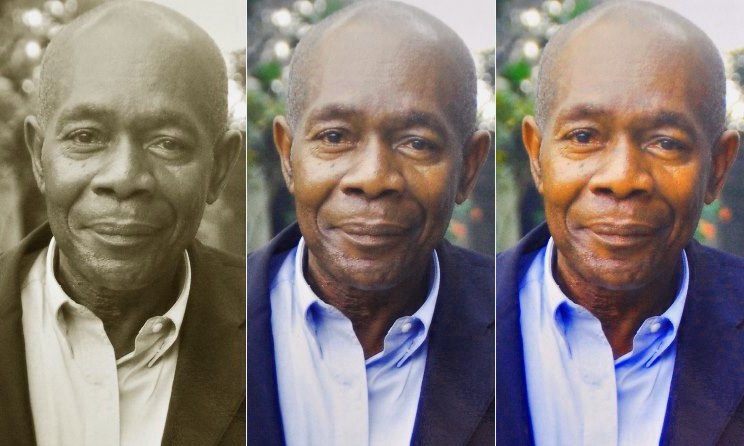
Meeting Peter King and Fela in the UK
I have had a very long and strong relationship with Peter King (born Peter Osobu) since the early sixties—as a good friend and admirer of his music, musical direction and achievements.
We first met in London in the early sixties when I was a University student, during what was later known as the Swinging Sixties and, when London was regarded as the world capital of contemporary popular music, with the advent of the Beatles, Rolling Stones and many British pop groups, the regular visits of the best American superstar jazz and pop musicians who came to London to perform in concerts, and the impressive beginning of black West Indian and African musicians evolving their own brand of rhythm-infused pop music.
I was aware and quite fascinated by a group of four Nigerians who were studying music at the Trinity College of Music in London, an affiliate of the University of London.
They were all much older than I was and quite unique in that, at that time, it was unusual for Nigerians to be studying music abroad at a very reputable and world-renowned tertiary institution solely for music, rather than studying the so-called elite professions of medicine, law, engineering, accountancy and so on. They belonged to the pioneer generation of highly trained Nigerian musicians and, not surprisingly, later became very influential innovators in the Nigerian and world music scenes.
These four Nigerians were Adam Fiberesima, Peter King, Fela Ransome-Kuti and Wole Bucknor.
Being a small close-knit community of Nigerians in London, we all interacted whenever Fela Ransome-Kuti, still a student, performed with his pick-up band at dance concerts organised by Nigerians. Adam Fiberesima, also still a student, performed with his own band at similar events. Peter King though, was more formidable and professional, as he formed and led a jazz band of Nigerian musicians called the African Jazz Messengers.
The African Jazz Messengers soon became one of Britain’s top jazz bands and Peter King himself was recognised as one of Britain’s top jazz tenor saxophonists. The African Jazz Messengers produced a hit single ‘Highlife Piccadilly’.
Fela, now known as Fela Anikulapo-Kuti; Adam Fiberisima, later Dr. Adam Fiberesima; and Wole Bucknor came back to Nigeria soon after their studies and made giant waves within the music industry. Fela eventually established the genre of Afrobeat music, which is now world-famous.
Fiberesima delved into the classical music genre and composed full-scale operas and symphonies based on Nigerian traditional folk songs. These operas, including ‘Opu Jaja’, ‘Oru Koro’, ‘Ibinu Ukpabi’, and symphonies like ‘Fantasia Origin’, ‘Highlife Symphony’, ‘Asiko for Strings’, were performed by symphony orchestras in London, Moscow, New York, Warsaw, Washington, Italy and Lagos. Bucknor became the Nigerian Navy’s first director of music.
Peter King's sojourn
Peter King stayed back in England after his studies at Trinity and pursued a career as a professional musician. He formed a new band named Shango, which was made up of Nigerian and West Indian musicians, and he gradually developed his innovative genre of Afrojazz music. He made a string of recordings, composed and performed music for television drama and toured extensively in Europe and North Africa with his band Shango.
For two summers, he attended the famous Berklee College of Music in Boston, America to study jazz composition and jazz improvisation. He became an accomplished, world-recognised jazz multi-instrumentalist, a virtuoso on the tenor saxophone, soprano saxophone and flute. As his war effort, he came to Nigeria and raised a band that entertained Nigerian soldiers on the warfront during the Civil War.
By 1965, I had ventured into music journalism and criticism and started writing for American music magazines from London. My first major article, for Change magazine, was a review of Ornette Coleman’s London concert during Coleman’s first-ever tour of Europe in 1965.
By 1966, I had relocated to America and was working as a poet/writer and music critic, contributing to prestigious music magazines writing specifically on jazz and blues music. And by 1970, I had become the first new music/electronic music editor of Downbeat, a specialist jazz music magazine regarded as ‘the jazz bible’ and read in 89 countries. I studied filmmaking with photography as a minor and became the Manager/Booking Agent of Sun Ra and his Arkestra.
It was therefore quite natural, that when I came back to Nigeria by the mid-seventies, I immediately registered my film company Sun Arts:BEP as one of the pioneer independent indigenous film companies in Nigeria.
Sun Arts:BEP has deliberately solely been working in the genre of documentary films and my first film on celluloid was Odum and Water Masquerades shot in Okrika in May 1974. In addition to making more documentary films, I continued with writing music and, arts and culture criticism, for Nigerian newspapers then like the Daily Times and other papers under the group, the Vanguard, the Guardian and the London-based weekly West Africa magazine.
Of course, I reunited with Fela and Fiberesima and wrote about them as well as other artists. I wrote extensively on Fiberesima in the Daily Times and West Africa magazine and, when he died in 2003, I edited a small tribute-book on him published by the Fiofori family.
With Fela, I had a hands-on relationship. I helped him arrange concerts in Port Harcourt where I was based, then made a documentary film on him in 1975, which unfortunately is temporarily missing in Sweden and, I designed the album cover for He Miss Road and, I regularly attended his rehearsals. It was at one such rehearsal at the Surulere Night Club, that, at his request, I wrote the lyrics for his hit song ‘Gentleman’.
I have since written a lot about Fela since his death, in commemorative books and I did an in-depth review of Benson Idonije’s great book This Fela Sef.
I started writing about Peter King in numerous Nigerian publications and West Africa magazine after he finally came back to Nigeria to settle following FESTAC ’77, which he performed at with his group Shango as part of the United Kingdom contingent. On his return to London, he was invited to Germany to become the musical director and bandleader for a TV series by the world-famous group Boney M. He had also recorded six well-received albums before his return.
Since his return, as a friend and admirer, I have keenly followed Peter King’s mammoth achievements and contributions particularly towards the development of the Nigerian music industry. I sincerely believe, and it’s on record, that Peter King has had an extraordinary career as a Nigerian musician, preaching his gospel of AfroJazz which has strong Nigerian rhythmic and melodic roots, all over the world for many years. Without a doubt, Peter King remains the model Nigerian musician who has given back most to the Nigerian music industry and Nigeria itself.
He has done this, emphatically, by establishing and running the Peter King College of Music Workshop, which is now 35 years old and is based in Ilogbo town, near Badagry, Lagos State.
It is a remarkable, one-of-its-kind music institute in Nigeria, maybe in West Africa, that has boarding facilities for male and female students who are offered one, two or three-year music tuition diploma courses as well as training on instruments from the violin to saxophones, percussion and voice training. Incredibly, it is self-funded and has over the years received help in cash and kind from the French government and some Canadian musicians.
The Peter King College of Music has so far produced over 2000 Nigerian male and female musicians who are musically literate. That is, they can read and write music and are instrumentalists, including female trumpeters, saxophonists, drummers, guitarists and pianists. One of its former students is Asa the singer-guitarist who studied there for a year.
It is therefore simply logical and timely that I should make a documentary film on Peter King’s musical career and unique contributions to music development in Nigeria. I, too, am self-funded. I started location work at the school in 2016, then was back in 2018 and am now at the editing stage, and hopefully, the film should be ready for release in 2020.
Government’s neglect
The fact that not more music schools like Peter King’s school exist in Nigeria today is a sad and true reflection of the government’s attitude towards the arts and culture sector. It is a lack of genuine understanding, of the importance and value of music in terms of its financial and manpower rewards.
America makes multi-billion dollars yearly from its music industry, from exports and internal consumption; music is taught at primary, secondary school and university levels in America; and there are millions of gainfully-employed male and female professional musicians in America.
Here in Nigeria, we have the ridiculous situation where music is not taught at primary and secondary school levels, yet it is taught at theory-level in some universities. We like to give many excuses for our endemic intellectual laziness and incompetence when it comes to important and very vital issues about modern and contemporary culture in Nigeria. They will tell you that musical instruments are expensive and we don’t have enough trained music teachers. The hard truth is that most of our so-called leaders and elite are culturally uninformed, illiterate and backward when it comes to music.
Yes, there are now thousands of young untrained Nigerian musicians, making millions of naira, but music is not only about money. Content and skills matter a lot if the industry has to progress in this modern global age. The few well-trained musicians prefer the comfort of teaching in universities and one cannot and should not blame them.
This is why Peter King remains a shining role model for having the concern and bravery to set up his own private and high-standard music school, as his much-needed contribution towards filling the yawning gap in music education in Nigeria.
It is no surprise that interest in live music in Nigeria has dwindled for many reasons. The night club or venue owner will tell you that live bands are expensive, or that there are not enough good live bands around to attract his potential clients.
The potential band musicians will tell you that musical instruments are too expensive for them to own and form bands and that there are not enough venues that provide steady well-paying gigs. This is why, interestingly, musicians now gravitate towards the growing number of Pentecostal churches who own musical instruments and provide regular platforms for live church music.
In fact, a good number of male and female graduates of Peter King’s school initially join church bands until some of them get tired of playing church music. In turn, Pentecostal churches send their member-musicians to Peter King’s school for further and better training.
Then there is the question of Nigerians’ present appreciation of live music. The emergency-music-DJs of the multiple radio stations across Nigeria, who themselves don’t have an appreciation or taste for live music, daily feed millions of Nigerian radio listeners plastic computer-enabled songs by the new megastar musicians, and many Nigerians, especially the younger generation like this type of music and sincerely, though wrongly, believe that this is the only type of music around. As they say, people get to like what they hear all the time. But there is no reason why, in Nigeria, live music and canned music, cannot thrive side by side as happens in the western world we are trying to emulate.
Documenting the Igbo flute and Peter King's music
My recent music documentary, on the Igbo flute called the oja, was inspired by a fascination with the sound textures of particular instruments and, musicianship.
This meant that I was very much attracted to Gerald Eze, a first class graduate of music from the Nnamdi Azikiwe University, Akwa, who had picked up the oja and learned how to play it for over 15 years, becoming a virtuoso.
I admired his mission, which is to elevate this seemingly simple instrument to the status of instruments like the trumpet and saxophone and to show that it can musically fit into various genres of world music like highlife, jazz and Afrobeat.
I made Ogbu-Oja Eze demonstrating his musicianship and how well he had incorporated the oja into highlife, pop and Afrobeat music for a start. It was a challenging film which I shot in one hectic day at three different locations in Lagos and, it came out quite well.
I was gratified when Ogbu–Oja Eze got a standing ovation at its first screening at the iREP International Documentary Film Festival in Lagos in March. Its distribution, as usual, is the next big challenge. So, I plan to enter it for more film festivals in Nigeria, Europe, Canada and America and, then, carefully explore the possibilities of online sales. I am exploring the same channels for my forthcoming work on Peter King, which is titled Peter King: AfroJazz Pioneer.
My hope is that it will be accepted in more upscale international film festivals—more so as Peter King is now recognised worldwide as an innovative musician as well as a music educator.


Most popular

Top amapiano songs of 2026
16 Feb 2026

Top Afrobeats songs of 2026
19 Mar 2026

Top Naija songs of 2026
31 Mar 2026
AFRIMA 2026: All the winners
12 Jan 2026
Open call: Goethe-Institut grants for Southern African creatives
08 Sep 2026

Sun-El Musician confirmed for ACCES 2026 in Joburg
15 Sep 2026
Open Call: Voices For Roxette invites artists worldwide to submit cover versions
15 Sep 2026
Disclaimer: Music In Africa provides a platform for musicians and contributors to embed music and videos solely for promotional purposes. If any track or video embedded on this platform violates any copyrights please inform us immediately and we will take it down. Please read our Terms of Use for more.

Subscribe to our monthly Newsletter
Follow us on social media


Please log in to post a comment.