


















































By Mariah Nene
The distinctive melodious sound that announces to a visitor that they have arrived at the East African coast, Taarab music helps give the region’s coastal towns their distinct identity and has been evolving ever since the first seafaring traders and explorers landed on these shores.
Taarab (also known astarabu or tarab) is a type of music that borrowsheavily from genres across the world. It has Indian, Persian, European and Arab influences with Swahili lyrics. According to Gilbert Rougetin the book Music And Trance(1985), the word taarab is a deviation of an Arabic verb “tariba”. This music is synonymous with the East African coast and is closely associated with Swahili culture and way of life.
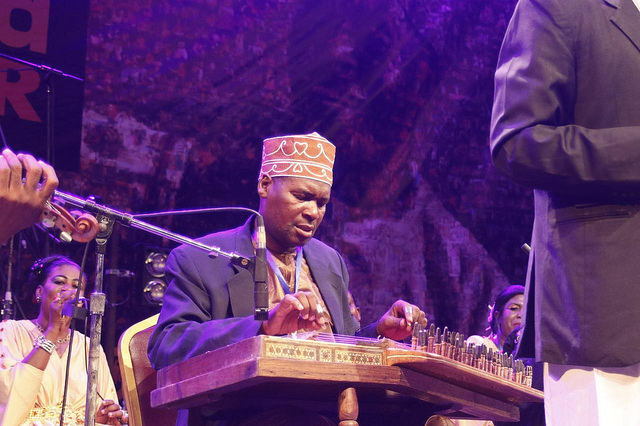
Taarab music is akin to sung poetry. Its lyrics typically talkof love and relationships, often witha creative subtlety known as “Lugha ya majazi” (imagery language), which is used to avoid conflict or fights in the community. It also serves as a means of learning “proper” Swahili. One of the key elements of Taarab instrumentation is the qanun (orkanun), a 72-string zither that lies flat and is plucked like a harp.The beat of the coastal music is driven by African drums.Tambourines and the accordion add to the melody and give it a Western feel.
History of Taarab
Taarab music has deep roots and is believed to have started in the Zanzibar Town off the East African coast. The many influences of this music reflect the various cultures that have passed through this trading area overmany years. As a regional art-form Taarab incorporates Swahili, Arabic and Egyptian cultures.
Taarab musicians play specific instruments, which help to give the music its unique sound and feel. The qanunis one such instrument. This is a string instrument played in the Middle East, Central Asia and South-eastern Europe. It is made of a narrow trapezoidal soundboard. Nylon or PVC strings are stretched over a single bridge poised on fish skins on one end, attached to tuning pegs on the other end. Theinstrument is placed in the lap and played by plucking the strings with twopicks carved out of tortoise shells. Fingers can also be used to play it. Other popular instruments in Taarab include the Middle Eastern oud and dumbek (drum), Indian tabla, Western electric keyboards and Japanese taishakoto (banjo).Its rhythms are a mixture of local chakacha grooves, Indian film music, Cuban and Congolese Rumba and other East African influences.Song lyrics - Swahili poetry -are considered a literary tradition in their own right.
According to popular understanding of the genre, Taarabwas brought to the Zanzibar coast by Sultan Said Barghash, who ruled Zanzibar from 1870 to 1888. The sultan, who loved music, brought a group of Egyptian musicians, who started teaching the local musicians Taarab. Due to the influence of the Swahili lyrics and traditional chakacha beats, the music received a facelift - it was no longer the same music that the sultan had imported from Egypt. The ruler then sent a Zanzibari musician named Ibrahim Muhammed to study music in Cairo. When he returned, he formed the Zanzibar Taarab Orchestra. The first band members of the group were Subeti Ambari (oud),Buda Swedi (gambusi and violin), Mwalimu Shaaban (tari and vocals),Buda bin Mwendo (violin) and Mbaruku Effandi (violin).In 1905, the second Taarab group, Ikhwani Safaa Musical Club, was formed. A branch of this group, Ikhwani Safaa and Culture Musical Club, continues to thrive today.It has around 35 active members and remains the top Taarab group in Zanzibar.
The Swahili coast stretched from Kismayu, Lamu, Malindi, Mvita (Mombasa), Zanzibar, Pemba, Tanga and Kilwa, all the way to the Seychelles. Taarab penetrated all these areas due to the presence of Arab traders. It even went beyond – inland to Burundi, Rwanda and Uganda. It was well received because it went hand in hand with the Muslim culture which similarly spread to these areas. Later,in 1964, in a political bid to remove the Arab influence in the region, all Taarab singers switched to Swahili, which became the lingua franca of the island, and clubs shed their Arab names for Swahili ones.
In Zanzibar, Taarab is closely associated with politics. This is because the first musicians of this genre were trained by Sultan Barghash to perform only in the palace. Groups like the Culture Musical Club started as part of the youth group of the Afro Shirazi party during the revolutionary struggle. Thereafter they became part of the Ministry of Culture in 1964. The Sanaa Taarab group is also under the control of the Zanzibar government. Some Taarab groups are permanently employed by political parties to promote their ideologies. For example, groups like Saniyyat Hubb, GoodLuck Coronation, Boomba Kusema and Lele Mama have been used in the past to mobilize support for one of Tanzania’s biggest political parties, theTanganyika African National Union (TANU).This is because political leaders have long recognized the social power of this music.
Siti binti Saad
Singer Siti binti Saad is a trailblazer who revolutionized Taarab music in a way that is still felt today in Zanzibar and all the other regions along the Indian Ocean coast where Taarab is popular. She was born in 1880 in Zanzibar,during the era of the Arab slave traders. Her family’s living conditions were deplorable and they engaged inpottery and agriculture to make ends meet.When she came of age, Siti left her home village for the city. Lacking any formal education, it wasn’t long before she met Ali Muhsin of NadiIkhwani Safa, a Taarab group indebted to the Sultan at that time. Muhsin recognized Siti’s gift and decided to teach her to sing along to the group’s Taarab instrumentals. She also played the tari or rika.
Siti’s contribution to Taarab should not be underestimated. Whereas her predecessors were all male and sang predominantly in Arabic, she was the first woman to perform in Swahili - a novelty at the time. The talented singer performed in Kenyan coastal towns, Tanzania (then called Tanganyika) and Zanzibar, her home. During this time it was considered immoral for women to join Taarab groups and to sing in public. Siti thus paved the way for female musicians in this genre. She helped to demystify women’s involvement in music within a culture where it was frowned upon and often ridiculed. She helped change people’s mindsets and transformed Taarab to the point where women are now usually the lead singers in Taarab bands, with men providing back-up vocals and playing the instruments. And by singing in Swahili, she ensured that Taarab music penetrated mainland East Africa because more people could now understand the lyrics.
In time, Siti’s singing prowess spilled beyond the borders of East Africa. Between 1928 and 1950, she recorded over 150 records at the Columbia Music Recording Company, based in Mumbai, India. Her music sold fast, withcompany executives hardly believing that over 72 000 recordshad sold in 1931 alone. Siti’s name continued to grow far and wide. She became both a tourist and cultural attraction as people flocked to Zanzibar just to see her. Columbia even established a branch in Zanzibar to enhance her music and tap into other local talent inspired by her sound.While recording in Bombay, Sitimet Egyptian singer Umm Kulthum. This meeting further developed the Taarab sound because she introduced an Indian dance style into it called natiki, derived from the Hindi natak. It is through her recordings and performances with musicians and poets from Mombasa and Lamu that Taarab became widely accessible throughout the region.Later, further Egyptian influence was incorporated into the genre, with many Taarab orchestras mimicking their Egyptian counterparts byincluding full string sections of violin, cello and bass, as well as the accordion, oud, qanun, keyboard and ney flute.
Throughout the world, Siti binti Saad’s name is synonymous with Taarab. Her music prowess was immortalized in her biography Wasifu wa Siti binti Saad, written by Shaaban bin Roberts. The book is still being used as coursework in Tanzanian secondary schools. Although she passed away in 1950, Siti is still remembered as the first womanin East Africa to record an entire album of her music.The Association of Women journalist’s ofTanzania (TAMWA) named their party newspaper Voice of Siti after her.
Bi Kidude
Another female pioneer of Taarab was Bi Kidude, born Fatuma binti Baraka in the 1910s (her exact birthdate is unknown) in Mfagimaringo Village, also in Zanzibar. By the 1920s, Bi Kidude had already started singing with local Taarab groups. At the tender age of 13,the talented singer fled Zanzibar to Tanzania to escape a forced marriage. She joined a Tanzanian Taarab group that travelled and performed all over East Africa.In 1930, she fled from another unhappy marriage to Dar es Salaam, where she joined an Egyptian Taarab group and remained for some time before returning to Zanzibar in the 1940s.
Bi Kidude is known for her role in the Unyago movement, which is a rite of passage that prepares young women for marriage.This cultural practice uses traditional rhythms to teach women how to relate to their husbands.The legendary singer is also famed as one of the greatest composers of African music. In 2005 she was awarded by the World Music Expo (WOMEX) for her contribution to music. Her life is documented in As Old As My Tongue: The Myth and Life of Bi Kidude,the 2006 documentary by Andy Jones.
Other legends of Taarab include Zuhura Swaleh, Bi Malika (real name Asha Abdow Saleeban),Ustadh Bakari Abeid, Ustadh Ali Mkali, the late Ustadh Seif Salim Saleh, and Zein L’ Abdin from Lamu, a master of the oud, which was first introduced by Kuwaiti traders when they sailed the Kenyan coastline during the 1920s and 1930s.
Taarab’s Influence On Music Today
Taarab has left a lasting impression on the music of East Africa, particularly genres such as Kidumbak, Beni and Modern Taarab. Kidumbak is a less refined and more upbeat genre than Taarab. Musically it falls in between Taarab and the traditional Zanzibar music known as Ngoma. Just like Taarab, it is performed during celebrations. Contemporary Kidumbak is often referred to us Kitaarab. Kidumbak is typically played in accompaniment with two small clay drums,a violin played in a frantic fiddle style, a sanduku or tea chest for the bass, and the cherewa, a kind of shaker made from coconut shells filled with seeds or mkwasa, short wooden sticks, played like claves. As opposed to Taarab, Kidumbak is more rhythmic and its lyrics more spontaneous than poetic. The songs often criticize social behavior. The singer should be able to string together various Ngoma songs into a medley accompanying the tune. The dancing and chorus is provided by the wedding guests. This music focuses less on Arabic instruments and more on local ones. Many musicians in Zanzibar, such as Makame Faki, for example, perform in both Kidumbak and Taarab bands.
Another genre influenced by Taarab is Beni, derived from the English word ‘band’. The genre emergedat the end of the 19th century as a mockery of British military bands.It focuses on rhythm and dance,with a strong emphasis on audience participation, and thrives on humour or mockery. The main idea is to have fun! Usually in Beni performances, a series of the latest Taarab hits are arranged in a medley, with females in the audience joining in the chorusand dance. It is also commonly performed during street paradesor wedding dances. The popular band Beni ya Kingi usually kicks off the opening parade of the annual Festival of the Dhow Countries.
Modern Taarab evolved from the traditional Taarab sound but has many notable differences.It is also known as RushaRoho (to let loose, or literally ‘make your spirit fly’).Modern Taarab can be classified as pop music andlacks much of the subtlety of the original Taarab sound – largely because its lyrics are direct and meant to annoy or openly criticize. For example, whereas traditional Taarab lyrics might compare a woman to a theatre chair, which anyone can sit on if they pay, Modern Taarab will instead refer to her directly as a kirukanjia (prostitute). Modern Taarab’s lyrics proved so controversial in Tanzania that in July 2005, the then Minister of Education, Culture and Sports, Haroun Ali Suleiman, demanded that female singers stop singing offensive lyrics that promoted disunity.
The main focus of Modern Taarab is dance and entertainment. This music is typically composed and performed on keyboards, which reduces the size of bands and allows musicians to be moremobile and flexible. Band members usually dress far less formally than their predecessors. Some critics dismiss Modern Taarabas an inferior reproduction of the original form. The evolution from original Taarab music to Modern Taarab was mainly due to the commercialization of the genre, the influence of the mainstream mediaand musicians and producers’ adoption to modern technology. Modern Taarab also draws on international influences. There is even a Modern Taarab version of American R&B singers Monica and Brandy’s hit ‘The Boy is Mine’.Another musician, Yusuf Mohammed (aka Tenge) translates the soundtracks of Indian films into Kiswahili and reproduces the melody on an electric keyboard. Another popular Modern Taarab group is Maulidi Musical Party from Kisauni, headed by Maulidi Juma.
The emergence of Taarab and its subsequent evolution offers a fascinating example of the variety and diversity of culture in East Africa. That it has survived for over a century says a lot about the genre’s popularity, although sceptics may fear that the future of this genregrows increasingly uncertain as the region’s musical tastes shift from the traditional to the commercial.


Most popular

Top amapiano songs of 2026
16 Feb 2026

Top Afrobeats songs of 2026
19 Mar 2026

Top Naija songs of 2026
31 Mar 2026

AFRIMA 2026: All the winners
12 Jan 2026

Open call: Goethe-Institut grants for Southern African creatives
08 Sep 2026

Sun-El Musician confirmed for ACCES 2026 in Joburg
15 Sep 2026

Open Call: Voices For Roxette invites artists worldwide to submit cover versions
15 Sep 2026
Disclaimer: Music In Africa provides a platform for musicians and contributors to embed music and videos solely for promotional purposes. If any track or video embedded on this platform violates any copyrights please inform us immediately and we will take it down. Please read our Terms of Use for more.

Subscribe to our monthly Newsletter
Follow us on social media


Please log in to post a comment.