






















































A detailed analysis of Fela Kuti's use of satire as a tool of social activism, as well as a generic overview of his career timeline and discography.
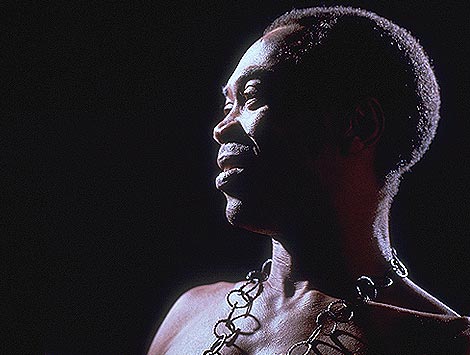
In African Traditional music satire has always been an unmistakable staple, with traditional singers using the vehicle of music to convey their displeasure or otherwise about individuals or societal ills, most times using thinly veiled or indeed idiomatic innuendoes- basically you knew who they were talking about but they didn't call names.
This tradition was carried on by the legendary Fela Anikulapo-Kuti into Afrobeat and in fact became one of his greatest trademarks. Fela’s satire was an inseparable part of his legend, inspiring, amusing irritating and confounding all at the same time- depending on who was listening of course. Satire became- to use a Fela term- “a weapon of war”. This was his legacy to his countrymen, to Africa and the world of social consciousness. This article will examine samples of his work that employed this medium and try to trace the evolution of his musical satire to full blown direct activism.
The Koola Lobitos Period: 1964-1968
Fela’s first band the Koola Lobitos, was formed in 1964 after his return to Nigeria from studies in the United Kingdom and after working as a Producer at the Nigerian Broadcasting Corporation. From the bands early tracks, the evolution of Fela’s satirical lyrics is observed in some of his releases in the period. This was clearly before Fela’s political activist phase. The theme’s floated around light-hearted and comedic themes. A sample of this follows:
‘Omuti tide’ 1964- This song referred to an alcoholic who lost his job on account of his love of booze, the thinly veiled reference here being to a well-known colleague of Fela and Benson Idonije (his first manager) at Radio Nigeria, where all three were producers, who went out for a drink and “forgot” to come back for a programme he was supposed to be managing and got suspended for his indiscretions;
‘Laise Lairo’. 1966- This song was about a man who “snatched” Fela’s girl and then got him locked up. Only to who later regret his actions, with the precise translation of the title being “If you didn't do it, you wouldn't regret it”.
‘Jeun Koku (Chop and Quench)’ 1968- The song refers to a greedy guest, who comes to his house and consumes all his food, drink and even the woman he left at home, basically saying get out of my house you greedy thief. This song was reputed to have been written about his close friend and musical rival Sierra Leonian Soul legend, Geraldo Pino, with whom he had a love-hate relationship. It’s interesting to note that Pino replied with a recording of his own called "Man pass man- Iron dey cut Iron" i leave you to judge who won the war after all the battles.
The early Afrika 70 period (1970-1973)
This period heralded the radicalisation of Fela and his emergence from the realm of innuendo to an outright challenge of the Nigerian authorities. Fela had travelled to the USA in 1969 and been radicalised by his muse, the Black Panther activist- Sandra Isidore. He returned to Nigeria a changed man, and this showed in his bold, fiery lyrics. He changed the name of his band to the Afrika 70, to reflect his new black nationalism. However there were still some of the old light-hearted jibes of the past. Samples of this follow:
‘Mr Who are You’. 1971- This song talks about a guy who had the temerity to question Fela's pedigree- Fela goes on to encourage the guy be roughed up for his impertinence. This song is reputed to be about Deolu Akinsanya, who was a popular Highlife Musician in Lagos at the time. Akinsanya, it is said, questioned who this young whippersnapper was. This clearly rankled the massive ego of a proud Fela, whose response was explosive. The lyrics in the song translated from Yoruba read thus "Shut your mouth, there're flies about, shut your mouth your breath stinks"...."he looked at me for ages and then finally asked, who the hell are you...Mr Who are you is here". Akinsanya did not respond to this.
Roforofo Fight- Basically a song about two roughnecks who got into a fight, in-spite of pleas from on-lookers. They eventually ended up fighting for ages and getting so roughed up and mud-caked, no-one could tell them apart. The classic opening lyrics "Gerraway, f..k away, who are you go and die; f..k away gerraway, who are you go and s..t" There are two schools on the origins of this track, one which I believe is authentic being that it referred to two young Turks at the Kalakuta Republic who first of all got into a verbal slanging match, which bystanders tried to mediate to no avail and ended up in a fight, which Fela, looking from his balcon,y then ordered that no one should mediate any further and that if they chose to fight they should continue. As the story goes, the guys fought for ages, falling into a swamp behind the Republic, coming out rolling in the sand, leaving them looking like two unrecognisable, but identical swamp creatures. Hence the lyrics- "dem go look like twins". The end result being that they both were so completely drained of energy, they actually begged to stop fighting, but Fela insisted that they must continue, since they had chosen to disturb his afternoon "relaxation". The other school of thought being that this was similar circumstance but which occured in Abeokuta- Fela's hometown. What’s certain is that the event at Kalakuta did occur, whether it was the motivation for the song, remains to be confirmed;
‘Yeye dey smell’ This song in Yoruba parodied a guy who got close to Fela's girl, with no hard feelings from him and when Fela returned the favour the guy lost his rag. This monicker Yeye dey smell was reputedly ascribed to Ginger Baker, who was Fela's guest and good friend at the time, probably in reference to Baker's beatnik aura. This was clearly a friendly disagreement between two close friends.
3. The Direct "Yabis" phase (1974-1979)
Yabis by the way is Nigerian patois slang for insults or satire, a slang Fela used frequently. Fela radicalised his message as time went on and rather than using the traditional indirect method now fearlessly called names and targeted the Nigerian Military establishment in particular, with dire circumstances. However with each incident, he was emboldened and relentless. Some of these actions and musical releases follow.
‘Gowon’- Fela christened his Pet Donkey- "Gowon" which was the surname of the Leader of the Nigerian Military Junta at the time, let’s just say that was looking for trouble;
‘Kalakuta Show’ After Fela's house was attacked and he was badly injured, he responded with this song basically attacking the Nigerian Police and chronicling the damage done by the so-called protectors of the public, the most telling lines being - "Look the man e dey waka, hungry dey run for him face, him pepeye cap for him head, khaki woolen short for him body, trouser dey fly above him knee"... "The people wey employ the man them give am permit to carry the thing wey e bad, they give mam permit to carry baton, bullet, teargas and basket for protection ....but one day... the whole thing change they actually use them teargas, baton and bullet and basket for protection, dem do one thing dem never do before, dem hire axe (-o) dem bring cutlass. This was a parody of the image of the miserable policeman, who ordinarily uses the standard weapons oppression- batons, bullets and teargas but one day went a step further by hiring axes and bringing cutlasses (matchetes) which they used in the attack on his house and (on him to be precise as he sustained serious head injuries in the attack). A bit of a comical aside in the song being the words "Look Lawyer, he dey come, look Lawyer dem beat am, Look Lawyer him dey run"- basically a friendly dig at his good friend and Lawyer Kanmi Ishola Osobu who had run to the scene to try and reason with the attackers, only to get whalloped himself and take to his heels after scaling a fence. This was one of Fela's most powerful albums.
‘Zombie’ Probably one of the most confrontational and controversial of Fela's satirical tracks. This track was a direct characterisation of soldiers (Nigerian soldiers more precisely) as Zombies, who are programmed to march forwards and backwards or kill and die, on order. It was fair to say it upset a few in the Military Junta ruling Nigeria at the time, and resulted in the attack on his house – the Kalakuta Republic and the rape and maiming of several of its inhabitants. The most prominent death, being Fela’s mother, the nationalist, Funmilayo Ransome-Kuti.
‘Unknown Soldier/Coffin For Head of State’. After the attack on his house, Fela released probably one of his most emotional albums- lamenting death of his mother and attack on his house. In Unknown Soldier, he refers to the fact that a Judicial enquiry came up with the result that the attack was carried out by Unknown Soldiers. In Coffin for Head of State, he refers to the death of his mother and heand his family's demonstration of defiance, by taking her coffin to the residence of the Head of the Military Junta asking him to bury her- since he was responsible for her death. These albums represented the full transition of Fela into an authentic fearless revolutionary.
4. The Egypt 80 phase (1980-1989)
This was a philosophical phase in content and characterised by more direct references in content, clearly Fela had lost none of his fire after his travails and rather than compromise was even more vocal and fearless.
‘ITT’. This was a direct attack on Moshood Abiola, the owner of Decca Records, Fela's previous label, who Fela accused of swindling him of his royalties. The lyrical attack being more focused on Abiola's alleged inept handling of a massive Telecomm's contract via the company he represented at the time in Nigeria ITT, which letters Fela modified to International Thief Thief;
‘Power Show’. A direct commentary on the oppression of the poor by the rich and powerful. The lyrics playing on instances in daily life in Nigeria.
‘Gbami leti kin dolowo’. (Slap me and make me rich)- Following from the theme in Power Show, this is a direct account about a "big man" who in an altercation with a "small man" threatens to slap him, to which he gets a reaction he isn’t expecting- total defiance and an invitation to "go for it if you dare".
‘Shuffering and Shmiling’. A direct commentary on the elitism of organised religion and the paradox of opulence that the religious leaders lived in whilst their congregation suffered and err.. smiled- famous line- “everyday my people dey inside bus, 49 sitting 99 standing, dem dey faint, de go wake like cock" Reference to the rat race in Lagos at the time.
‘Teacher don't teach me nonsense’. A direct take on neo-colonialisation and western indoctrination of the African socio-political mindset- memorable lines "Demo-crazy, Crazy Demonstration, Demonstration of Craze, dey bad more and more...."
5. The 90's:
Fela's mind and body had taken a huge battering over the years however the effect it was to have on his compositions, being to evolve a deeper visceral, almost ethereal satire. Fela would - at his Friday Night Sessions at his club, the Afrikan Shrine and even on Saturday Night sessions, launch into deep, intuitive monologue. This generated laughter at the time, but on hindsight, was a visionary seeing things well before their time Samples of his verbal and musical satire at the time include the following:
- In response to the annulment of the June 12 elections- Fela's comment being "Babangida make himself Referee, Goalkeeper and Striker and Abiola wan play football match with am, in fact the only reasonable man for the whole matter na Babangida"
- Fela often delved into the Yoruba idiomatic conotations of common-place words for instance Technology was transmuted by him to "Te ki Ina lo Jin" (press it and let the light shine far).
Fela recorded a few tracks in this period many of which were never released, two of the released recordings- which had in any event been played live at the Shrine for a few years in the late 80's- being:
‘Overtake Don Overtake Overtake’- A direct take on the dire economic circustances in Nigeria in the late 80's and early 90's, the memorable line being "Government come announce second tier everything come tear to pieces..even water sef come expensive, second bass jare!" This being a take on the second tier foreign exchange market and other market liberalisation policies introduced by Military leader Ibrahim Babangida, which caused hyper inflation. The line about the second Bass, referring to the introduction of a second Bass Guitar line to the track and a cue to the second Bass Guitarist to "enter"
‘Beast of No Nation’. Another direct take, this time on the International Community- referring to the ineffectual handling of the apartheid problem in South Africa- specifically directed against the United Nations. The memorable lines being "wetin United for United Nations, one veto equal to 92, East, West Bloc, West block East" and the awesome hooks "No be me dey talk, na Prime Minister dey talk, him say, this uprising will bring out the beasts in us"..."Beast of no Nation, egbe kegbe na bad society". Translation: What’s united about the United Nations? Where one veto vote is equal to 92. Where the East and West bloc, constantly block any kind of progress for the organisation. A reference to cold war politics.
As said Fela's compositions became even longer and more introspective, however the lyrics were stronger and more introspective betraying even greater sadness about his home country, but with a ring of hope that there could still be change. A couple of the unrecorded tracks, which became a staple at the Shrine in the mid-90's and up to Fela's death being:
‘Chop and Clean Mouth like say nothing dey happen na the new name for stealing’. In my view one of Fela's best. A direct and savage attack on corrupt Nigerian governments, right from independence. The song has a positive end though, saying that hope is not lost that Africa will prevail: "E no go happen, e no go happen, because Shrine dey, Africa must dey, lai lai o, lai lai o, e no go happen" Translation: They cannot take our souls, because the spirit of independence and radicalism that his Afrikan Shrine embodied and sought to implant in the minds of its disciples, would prevail.
‘Akwunakwuna senior brother of perambulator’. Another Shrine favourite. This song being an attack on the absurd policies and corrupt actions of some Nigerian governments and organs. The word Akwunakuna being local slang for a prostitute and being in direct correlation to the same theme in Chop and Clean mouth above.
These songs were sadly never recorded or released before his death.
Conclusion:
The songs listed on this page are but a mere sample of Fela’s huge catalogue of rich and powerful lyrical legacy. 17 years after his death, the still continue to inspire new and curious audiences all over the world. For his die-hard-fans, these lyrics will continue to be the soundtrack to the yet important call for peaceful and positive social change,


Most popular
Call For Applications : ACCES seeks a UK-based performer
10 Sep 2026

Top amapiano songs of 2026
16 Feb 2026

Top Afrobeats songs of 2026
19 Mar 2026

Open call: Ernst von Siemens Music Foundation 2026 funding programmes
04 Sep 2026
Open call: FAME Week Africa, Pressure Cooker Studios songwriting camp
09 Sep 2026

Open call: Goethe-Institut grants for Southern African creatives
08 Sep 2026
AFRIMA 2026: All the winners
12 Jan 2026
Disclaimer: Music In Africa provides a platform for musicians and contributors to embed music and videos solely for promotional purposes. If any track or video embedded on this platform violates any copyrights please inform us immediately and we will take it down. Please read our Terms of Use for more.

Subscribe to our monthly Newsletter
Follow us on social media


Please log in to post a comment.