






























































By Prof Mellitus Nyongesa Wanyama
The case of music education in Kenya suggests that despite a clear government policy, problems at primary school level can have a drastic impact on later levels of music education.
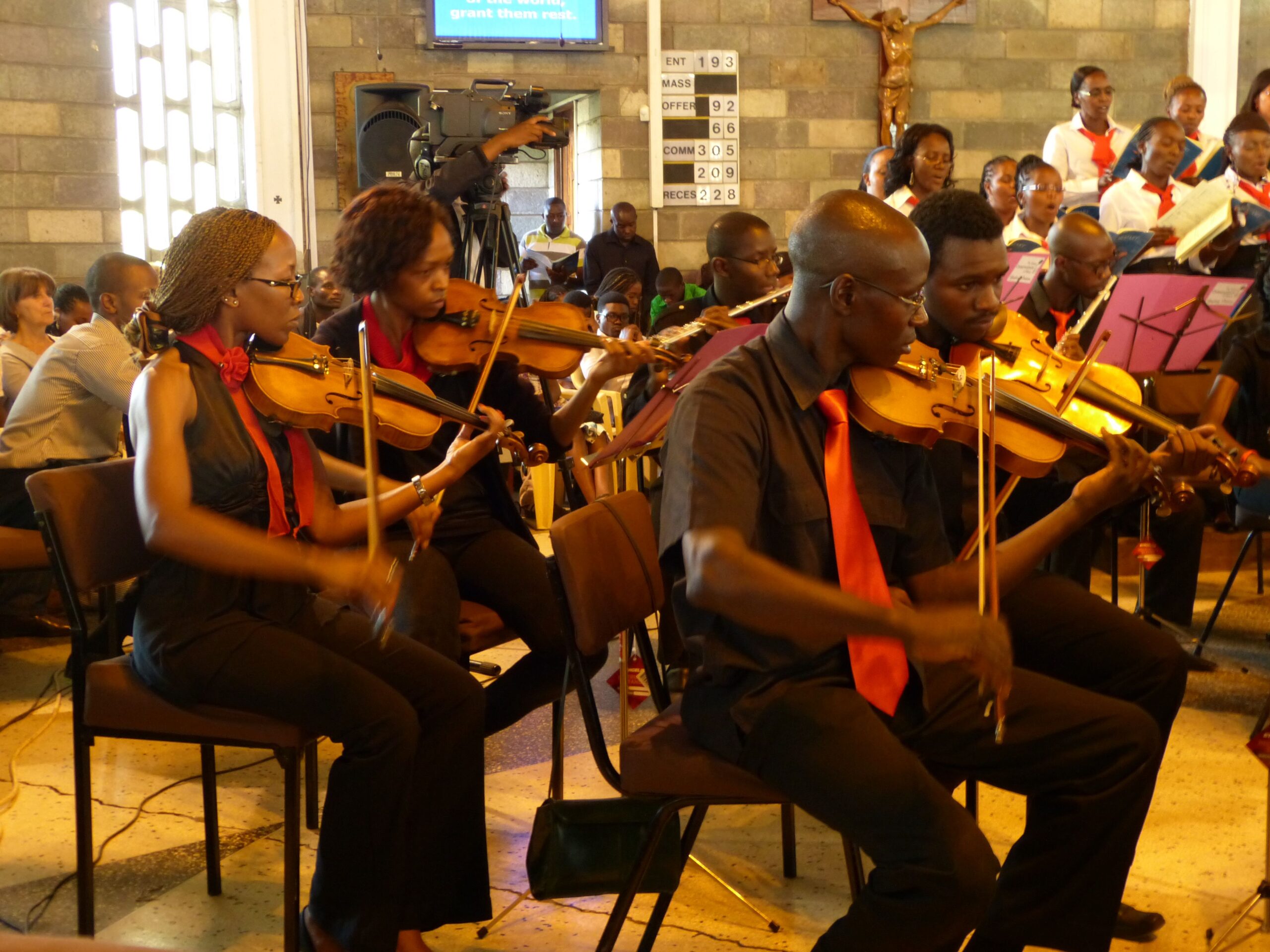
On its inception in 1984, the 8:4:4 (8 years in primary, 4 years in secondary and 4 years in university) system of education in Kenya advocated for the implementation of a curriculum in which music was a compulsory and examinable subject at primary school level and an elective but examinable subject at the secondary and university levels. Initially this move encouraged talented young musicians to sharpen their skills in music making and performance. Today, many people who underwent the 8:4:4 system (such as music teachers, composers and performers) are able to earn a living from their respective professions in music.
However, by the year 2000, the Ministry of Education in Kenya had made sure that music was neither a compulsory nor examinable subject in primary schools. At secondary school level, it was made an elective and examinable subject. This move has led to a difficult situation, where relatively few teachers and students have an interest in the subject at primary school level. Consequently, a negligible number of students at secondary schools have background knowledge and/or interest in the subject, and their development suffers. This vicious cycle replicates itself up to the university level.
Mindoti (2010), in his paper “The Development of Music as an Academic Discipline in Kenya”, highlights the struggles facing the position of music in Kenya’s school curriculum. He argues that because the Kenyan education system is examination-oriented, non-examinable subjects such as music at primary level are in practice not being taught. Schools instead focus on what will improve their overall mean scores. Due to this situation at primary school level, Mindoti warns that the number of secondary schools offering music may continue to drop. This implies less demand for music teachers, hence university enrolment in music has also declined and could continue to do so. This has affected the development and growth of university music programmes. For instance, Maseno University’s Music Department was merged with its Theatre Studies Department due to the low enrolment of music students. As a consequence of the low student enrolment figures, staff recruitment also suffers. Mindoti concludes that generally, developments witnessed since the inception of the 8:4:4 system of education have been negative (Mindoti, 2010).
This view summarizes the current situation of music education in Kenya. Educational neglect has impacted negatively on music education and teaching at all levels. Since music is not examined at the primary level, teachers and pupils tend to not take it seriously. At primary schools, classes scheduled for music education are often used for teaching other examined subjects like English or mathematics.
Attitudinal factors may also be causing the dwindling number of candidates for music education positions each year. At secondary school level, where the subject is optional and examined, pupils who were inadequately prepared in music education at primary school level commonly develop a negative attitude towards it. The optional status of music at school sends a signal to some students that it is not an important subject that needs to be learned.
In the long run, this attitude and situation has had a spillover effect on tertiary institutions, such as universities and teachers’ colleges. Because of this situation, many teachers who were trained at university level as music teachers are turning to teaching their second subjects instead and abandoning music altogether. At Moi University in Eldoret, Kenya, for example, there have been four cases of teachers initially trained as music teachers enrolling to pursue higher education degrees in fields other than music education. When asked why they made such a move, they cited their lack of future prospects and the poor “marketability” for music teachers in Kenya.
Similarly, trainees at primary-level teacher training colleges often don’t regard music as a worthwhile subject because of music not being given any emphasis in the primary school curriculum. After all, many teacher trainees may not teach music at all, except for a few who may teach at private schools offering music for foreign exam purposes, such as the London GCE and Royal School of Music exams. So what then is the logic of the government spending resources on training personnel, especially at the collegiate level, when the teachers are not utilized?
Since academic excellence in Kenyan schools, and to some extent tertiary institutions, is based on the level of the mean score obtained by candidates in annual national examinations, a new mechanism should be put in place so that non-examined subjects such as music can be taught more effectively.
Kenya Music Festival
Ironically, despite the unfortunate situation facing music education in Kenya, the country still organizes and successfully administers on an annual basis one of Africa’s largest competitive music festival for schools, colleges and universities. The Kenya Music Festival, which is organized by the Ministry of Education, attracts tens of thousands of students from kindergarten to university level over a period of about two weeks. The events’ objectives are to:
- Encourage the study, practice and development of music dance and elocution.
- Provide a forum for promising performers of music, dance and elocution to expose their talents.
- Promote the preservation of Kenya’s rich cultural heritage.
- Document and disseminate Kenya’s rich artistic output.
- Promote international awareness through the performance of music, dance and elocution.
- Promote the quality of performance in music, dance and elocution.
- Encourage creativity that will embrace emerging issues.
- Provide a forum for cultural interaction that will foster national unity and
- Identify opportunities for career development (KMFF, 2014).
The festival’s participants compete in the following areas: set pieces, folk songs, African folk dances, original compositions, arrangements and adaptations of existing music, and oriental, classical and instrumental music. Although the festival is one of the ways of identifying and nurturing talent in music and elocution, as well as teaching music (as is argued by the Ministry of Education), it does not evaluate participants through structured examinations in the same way that the Kenya National Examinations Council does for other subjects. Instead, the festival provides certificates of participation to all participants at the national level (KMFF, 2014).
It is worth noting that participants in the festival’s competition progress from zonal, district, county and regional levels all the way to the national level. The national level is final in a sense that it does not provide opportunities for those who excel in various categories to further advance their educational development. In the recent past the Ministry of Education has established a Talent Academy in Nairobi for students gifted in performing arts or sports, but due to inadequate funding and weak organizational and administrative structures, the impact of this academy has not been felt country-wide.
As a way forward, it is prudent to recommend that the government needs to reconsider music education in Kenya and at least make music examinable at primary school level. Such a move will help to prevent the problems currently being experienced at primary level from spilling over to secondary and tertiary levels, thereby promoting quality music education in Kenya and realizing numerous benefits in the country and beyond.
REFERENCES
Kenya Music Festival Foundation (KMFF). 2014. Kenya Music Festival Syllabus. Nairobi: Ministry of Education.
Mindoti, WM. 2010. ‘The Development of Music as an Academic Discipline in Kenya (1978–2002)’. Music in Kenya: Development, Management, Composition and Performance: A Tribute to Daniel T. Arap Moi. Nakuru: Kabarak University.
Wanyama, MN. 2006. ‘Music Education: An Unexploited Goldmine in Kenya’. Boules, C & D. Rohwer (eds.) International Journal of Community Music. Proceedings of Music and Lifelong Learning Symposium of April 14-16, 2005. Madison, US: University of Wisconsin-Madison.
Disclaimer: Music In Africa's Overviews provide broad information about the music scenes in African countries. Music In Africa understands that the information in some of these texts could become outdated with time. If you would like to provide updated information or corrections to any of our Overview texts, please contact us at [email protected].


Most popular

Call For Applications : ACCES seeks a UK-based performer
10 Sep 2026

Top amapiano songs of 2026
16 Feb 2026

Top Afrobeats songs of 2026
19 Mar 2026

Open call: Goethe-Institut grants for Southern African creatives
08 Sep 2026

AFRIMA 2026: All the winners
12 Jan 2026
Open call: Ernst von Siemens Music Foundation 2026 funding programmes
04 Sep 2026

Open call: FAME Week Africa, Pressure Cooker Studios songwriting camp
09 Sep 2026
Disclaimer: Music In Africa provides a platform for musicians and contributors to embed music and videos solely for promotional purposes. If any track or video embedded on this platform violates any copyrights please inform us immediately and we will take it down. Please read our Terms of Use for more.

Subscribe to our monthly Newsletter
Follow us on social media


Please log in to post a comment.