






















































Midway through another year, we would have been chanting the praises of the men of Afrobeats, but not in 2024, which is witnessing new peaks within African pop divadom, thanks to recent albums from Tyla, Ayra Starr and Tems, a spunky trio driving a fresh discourse on modern fusions.
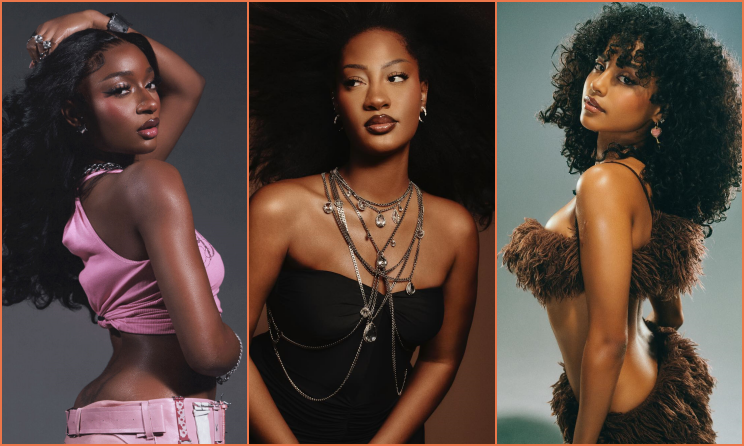
Ayra Starr and Tems’ LPs were released this month, with only a week between them. Ayra Starr’s project, The Year I Turned 21, marks her second full-length release, while Tems’ Born in the Wild is her debut album following two well-received EPs. On the other hand, Tyla’s eponymous debut was published in March.
While they may have the personality of Afrobeats and lean towards the experimental tag, all three albums unfold through the arteries and veins of R'n'B. The genre is effective for facilitating biographical work, led by tales about love and intimacy. The depth of field of these new projects is largely coloured by the aforementioned.
R'n'B and self-obsession constitute underlying parallels among the albums. However, equipped with Gen Z sass, Ayra Starr and Tyla, in particular, articulate taboo phrases with the same freedom as you would read a grocery list, and their presence is characterised by bold imagery, often revealing plenty of skin. It seems that this forms an essential aspect of their branding.
Tyla caught the world’s attention with ‘Water’, teasing and tantalising, and serving as a focal point of an album oozing seduction and serotonin. “Make me sweat, make me hotter / Make me lose my breath, make me water,” she instructs in the hook.
Ayra Starr shed her innocence years before, on 19 & Dangerous, so the new album is a sort of update. ‘Control’ celebrates nocturnal recklessness, drawing inspiration from Shakira’s 2005 hit with Wyclef Jean. While Shakira famously declares her hips as instruments of truth, Ayra Starr highlights the double meanings in an aroused woman’s words, and a theory on what can constitute consent. “I’m lit tonight / You know my lips lie,” the line goes.
“I want you to take control,” Ayra Starr says about the record. “I want you to be the man. Do your thing. It’s not really about submission, it’s more like I’m giving you hints – take control.”
Gen Z or not, they know what they’re doing. “I’m makin’ history / I don’t think there’s ever been any like me from these parts,” Ayra Starr sings on ‘Orun’, which constitutes the thrust of her album.
Ayra Starr and Tyla were clearly influenced by sex-positive champions like Tiwa Savage. Tems, a millennial, seems to take notes from Waje and Omawumi, relying on powerful vocals and wistful genius. It is why her work is more versatile, more soulful, more mature, more interesting. Often, her voice reminds you of Marvin Gaye, Sade and Brandy. Some of the most memorable moments on Born in the Wild are the stripped-down segments (‘Born in the Wild’, ‘Boy O Boy’) where Tems’ voice is accompanied only by an acoustic guitar.
The African sound is now global, propelled in particular by social media, digital streaming and a renewed interest from major record companies. With social media playing a crucial role in music promotion, women will lead the aesthetics contest for obvious reasons. In fact, as of January this year, women accounted for 52% of TikTok’s active users. Gen Zs constitute a key demographic of digital music consumers, driving the success of African artists on the international stage. In the US, the centre of global pop, 47.4% of TikTok users are under 30. According to Luminate’s 2023 Music Impact Report, TikTok users make up the “most fervent music consumers”.
In 2024, sub-Saharan Africa – home to Tyla, Ayra Starr and Tems – was the only region to surpass 20% growth in music revenues, according to the International Federation of the Phonographic Industry’s latest Global Music Report. This was driven by a 24.7% increase in paid streaming (+24.5%). South Africa, the largest market, contributed 77% of regional revenues, growing by 19.9%.
According to Spotify’s 2023 Culture Next report, Gen Z music and podcast consumption has surged, with more than 560 billion songs and 3 billion podcast episodes listened to in the first half of the year. This represents a 76% increase from the previous year and establishes Gen Zs as the platform’s fastest-growing demographic.
African pop has come a long way; impeccable production is a non-negotiable. While this is excellent, the landscape faces two key problems: a lack of innovation and little room for new artists to develop. The industry expects them to be ready-made stars, even at 21. Artists like Ayra Starr and Tyla particularly represent this arc, with their albums needing to excel at all costs. Both artists have impressive streaming numbers; Tyla’ debut album, which was released on 22 March, has already surpassed 1 billion streams. I suspect that Tems has also been confronted with the commercial demands that come with major record deals, the reason it took three years for her debut album to tide ashore.
The African woman is a fount of boundless soft power. The continent’s most impactful acts globally have always been women. Beninese legend Angélique Kidjo boasts five Grammy awards, more than any male African act. Kidjo, together with fellow doyens like South Africa’s Miriam Makeba and Yvonne Chaka Chaka, remain among Africa’s most important cultural voices. Still, to see women assert their influence this strongly within an industry long dominated by men (Wizkid, Davido, Burna Boy) signifies a major shift to something highly progressive and highly impressive.
We have a growing, more professional industry to thank, as well as initiatives like Spotify’s EQUAL programme, which amplifies the voices of African women in music, breaking down barriers and promoting their work to a global audience. EQUAL lists Tyla, Tems and Ayra Starr among its notable alumni.
They may not be filling up large venues yet like their male counterparts, but Africa’s new pop queens are showing that there is still room for experimentation and growth despite occasional stagnation. It took their predecessors several albums to forge formidable legacies. The trio highlighted here appears to require far fewer releases to make a significant impact.





Disclaimer: Music In Africa provides a platform for musicians and contributors to embed music and videos solely for promotional purposes. If any track or video embedded on this platform violates any copyrights please inform us immediately and we will take it down. Please read our Terms of Use for more.

Subscribe to our monthly Newsletter
Follow us on social media


Please log in to post a comment.