


























Mali’s orchestras from the 1960s to the 1980s
Mali’s independence in 1960
In the 13th century, Sundiata Keita ruled over the Mandingo Empire that extended over the Sahara and the Atlantic Ocean up to the Gulf of Guinea. Although the empire collapsed in 1535, the griots continued to pass down the Mandinka culture, unifying the country through their pivotal role in society. Three symbolic instruments are the balafon, ngoni and kora. After partial autonomy in 1956, as part of the Federation of French West Africa, Mali became independent on 20 June 1960. President Modibo Keita founded the National Orchestra A, led by Panga Dembélé and Kélétigui Diabaté, followed by Orchestras B and C. Based on a socialist model, these orchestras were heavily inspired by their Guinean neighbour Ahmed Sékou Touré, who a few years earlier made the African Ballet of Fodéba Keita his emblem and created the state label Syliphone in 1958.
Unfortunately, the National Orchestra A only released one album in 1970 to ‘safeguard the Malian cultural heritage’, according to the sleeve notes. Economically fragile, Mali only followed the Syliphone example in 1970 with an ephemeral partnership between the Ministry of Information and the German label Bärenreiter Musicaphon, which led to the release of about 15 LPs, which have since virtually disappeared.
The emergence of regional orchestras
Modibo Keita, still inspired by the Guinean model of Sékou Touré whom he visited in 1962, established the National Youth Weeks to stimulate artistic creation, following the cultural policy of authenticity. The idea was to stand out from colonial influence. In reality, these orchestras more or less absorbed all modern music genres. Consequently, orchestras thrived in all regions of this vast country, the largest in West Africa after Niger.
Born in the 1960s under the leadership of the trumpeter Amadou Ba[i], the band Super Biton de Ségou -a fusion of the group Ségou jazz, Alliance jazz and Ségou Regional Orchestra – was undoubtedly one of the best. Between 1970 and 1976, its accomplishments were rewarded with numerous performances at Art biennales organised in Bamako.
Besides the famous National Badéma, other orchestra formations emerged, such as the Orchestre Regional de Kaye, Tijwara band from Kati, Mystère Jazz from Timbuktu, l’Orchestre Kanaga from Mopti, Kéné Star from Sikasso and Koulé Star of Koutiala, in which the virtuoso pianist Cheick Tidiane Seck began his career. These orchestras, with amplified instruments, as well as Guinea’s famous Bembeya Jazz, were reflections of their time. Their repertoires included traditional Mandinka music, Afro-Cuban music popular since the 1950s and popular rock ‘n’ roll songs. This was the ‘Salut les copains’ [CJDR1] generation[ii]. Boubacar ‘KarKar’ Traoré’s 1963 hit song ‘Mali Twist’ illustrated this evolution.
1969: The Super Rail Band de Bamako vs Les Ambassadeurs du Motel
In October 1969, saxophonist Tidiane Koné from the National Orchestra A, the first to introduce this instrument in Mandinka music, founded the Rail Band de Bamako. From the Buffet Hotel of the railway station run by Aly Diallo, the orchestra played popular songs ranging from traditional Mandingo songs, French variety to salsa. The Rail Band became the first dance orchestra of the country and a talent factory where Kanté Manfila (under the leadership of the guitarist Djelimady Tounkara) spent most of his career.
At this time of nationalization, musicians were employees of the railway and their instruments were state-owned. Cheick Tidiane Seck, who joined the Rail Band in 1975, remembers this musically exciting time: “In 1974, I was jamming all the time with the Rail Band and Les Ambassadeurs. I was the only one to play Jimmy Smith. Lots of people were impressed when I played the entire repertoire of Motown. I played keyboards, organ and vintage synths with the Super Rail Band. Meanwhile, I had a band, the Afroblues – we performed at all the end-of-year parties with Alpha Thiam and Moussa Diallo (who now lives in Denmark) and did covers of Joe Cocker, Pink Floyd, Led Zeppelin, Deep Purple, Santana and above all, Jimi Hendrix! On Sunday nights, I played waltzes, tango, pasodoble and mazurka for tourists at the largest hotel of the time: l’Hôtel de l’amitié.”[iii]
In July 1970, a shy young albino took his first steps in the Rail Band before leaving for Les Ambassadeurs three years later. This young man was none other than Salif Keita. Mory Kanté, the golden voice of Guinea-Conakry, replaced him at the last minute. “I started at the time of Salif as a guitarist, bassist, drummer and balafon player. I filled all the gaps,” remembers Mory Kanté. “I accompanied Salif for a year and a half. We came to Dakar. The guitarist fled to join Orchestra Baobab. We had to play for Senghor at the Hotel Ngor. Tidiani Koné told me to play. I told him: ‘I play the guitar and that’s it!’ Tidiani also prompted me to sing for the Rail Band. When I played guitar, I performed the same songs I sang with my orchestra Apollo. The Buffet hotel was packed! Everyone stopped by. I was clean-shaven, wearing a red handkerchief on my head. Those were the good old days!”[iv]
In that same year, Les Ambassadeurs du Motel de Bamako emerged from the ashes of Les Éléphants Noirs, a band from Bouaké in Ivory Coast. The name ‘ambassadeur’ illustrated cosmopolitanism in an orchestra of Malians, Ivorians, Guineans (like the trumpeter Kabine ‘Tagus’ Traoré and the conductor Kante Manfila, who joined the group in 1972), as well as Senegalese (like the singer Ousmane Dia, a former member of the Star Band from Dakar).
In the Marxist context of the time, the Bamako Motel belonged to the state. On 19 November 1968, Moussa Traoré overthrew Modibo Keita. Artists had to deal with the dreaded Military Committee for National Liberation. Tiekoro Bagayoko, then director of security services, monopolized the place and became the official ‘patron’ of the orchestra, a real dance machine inspired by legends such as Celia Cruz, James Brown and Fela Kuti. The rivalry that then drove the two orchestras was both political and musical in a turbulent political context, to the point where in 1974, the two rivals competed against each other. Nobody could decide between them. A shortened version of ‘Kibaru’, a 22-minute song from Les Ambassadeurs performed by the Rail Band, finally reconciled them. This golden age did not last as Salif Keita and Mory Kanté sought better opportunities in Abidjan, Ivory Coast in 1978.
Salif Keita: The Griot
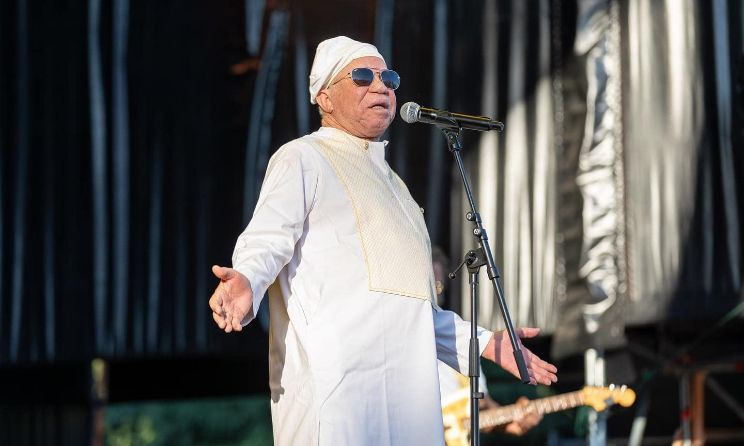
It is difficult to describe this golden age without mentioning Salif Keita. For over 40 years, he has been the most renowned Malian artist worldwide. Above all, he has gone through all periods of Malian music and was the product of the era of the great orchestras. Born from noble origins 1949 in Djoliba (30km from Bamako), the griot is a descendant of the Emperor Sundiata Keita. Despite being ridiculed as a child because of his albinism, the young Salif Keita found an opportunity in October 1969. Tidiani Koné, once again, happened to hear his outstanding voice when he performed at the Istanbul Bar in Bamako. In an interview with Francis Dordor in 2002, Salif recalled: “With the Rail Band, I finally felt that people could love me!” For the first time, the shy griot was in the spotlight. The cover of the first album of the Rail Band de Bamako in 1970 showed the nine members of the group dressed in railroad workers’ clothes in front of a locomotive of Mali railways –a real ‘cult’ album!
Salif stood out in the Rail Band. However, you cannot put two giants on the same poster. In the spring of 1973, Salif passed the mike on to Mory Kanté and joined Les Ambassadeurs du Motel de Bamako, with whom he recorded fabulous classics such as Les Ambassadeurs du Motel Volume 1 and 2 (Sonafric, 1977). Part of this repertoire was included in a compilation released by Syllart/Sterns in recent years. While Keita has since led a successful solo career, from ‘Mandjou’ to ‘Moffou’, he never forgot those years. This was shown at the 2015 Musiques Métisses festival in Angoulême, France, where members of Les Ambassadeurs reunited with former members Cheick Tidiane Seck and Amadou Bagayoko (other concert dates are scheduled).
The 1980s: The decline of orchestras and emergence of a new generation
The military regime of Moussa Traoré reigned supreme in Mali until the coup d’état on 26 March 1991. Given the tense political context, many talents sought their fortune elsewhere, unwittingly contributing to the decline of orchestras in the country.
In 1976, Tidiani Koné had joined groups like the Tout Puissant Orchestre Poly-Rythmo de Cotonou in Benin, Joanes Makoviain Niger and Harmonie Voltaïquein Burkina Faso. Ivory Coast was then the region’s musical hub, welcoming artists of all genres like the Malian Boncana Maiga and the Cameroonian Manu Dibango, who were directors of the RTI orchestra in 1974 and 1975 respectively. Cheick Tidiane Seck recalls: “At the end of 1978, my mother, seeing my tensions with the regime, gave me her blessing to go elsewhere. Salif Keita and the arranger Alassane Soumano sent me a telegram. I asked the Buffet hôtel de la gare, owner of the Super Rail Band, for leave to see my brother in Burkina Faso. I am still on leave! Actually, I joined Kanté Manfila, Salif Keita and the rest of the Rail Band in Abidjan.”
The 1980s shaped the concept of ‘world music’. Paris and London were the new hubs. Orchestras were obsolete as they were too expensive. Audiencesdeserted the genre, the state withdrew its support. Now was the time for performers who made a living particularly from Sunday wedding parties. This was illustrated in Amadou & Miriam’s ( ) famous song: ‘Les Dimanches à Bamako’. Interestingly, Amadou Bagayoko also debuted as a guitarist in Les Ambassadeurs. Other former members such as Mory Kanté, Salif Keita, Kassé Mady Diabaté ( ) and the late Ali FarkaTouré all had international careers and were produced by labels like Hannibal, Mango, Barclay, Syllart and World Circuit, working with producers like Ibrahim Sylla, Nick Gold and Mamadou Konté.
New voices have emerged since the 1980s and 90s. These include Habib Koité and his Bamada, the divas Oumou Sangaré, Ami Koita and Babani Kone, followed by Rokia Traoré and Fatoumata Diawara. Ballaké Cissoko and Toumani Diabaté continued the legacy of their ancestors.
Even though small bands now dominate in Mali, the famous korafola Toumani Diabaté paid tribute to those orchestras and the history of his country through the album Boulevard de l’Indépendance (World Circuit, 2006). Just like in the old times, this album was performed by a pan-African orchestra: the Symmetric Orchestra. « I wanted to culturally represent the Mandingo Empire with musicians from all those countries,” says the artist. “We have similar cultures. We sing the same music. We eat the same dishes. Peanut paste is called ‘Mafé’ in Gambia and Ivory Coast, in Mali we say ‘Tigadéguéna’ – but it’s the same thing! It’s important to produce a collective work for the new generations to hear.”[v]
With the cultural vitality of his country, Diabaté felt confident in Mali’s musical future. At the same time, however, the griot expressed concerns: “Great orchestras like Super Rail Band are becoming rare in Africa. With advanced technology, the work of 30 people is reduced to a guy who manipulates a computer in a studio. We no longer need all these musicians. However, the computer does not have emotions. When a musician plays, he can be mediocre if not inspired – but he can also excel! ”Interesting advice for future generations!
Further reading
<>··



