









































By Francis Basatzinda
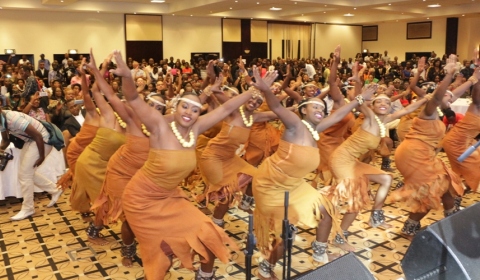
Music is one of the pillars that constitute the cultural heritage values of Rwanda through which its culture and behavior are manifested. It has been for a long time a source of unity among people who are brought together through music in different circumstances. Music is a valuable art: apart from pleasing the ear, it arouses imagination, and helps to express feelings and control passions. In Rwanda, music education is one of the many subjects that students are obliged to undertake at different levels of education. During the country’s nine years of basic education (6 years in primary and 3 years in secondary), music education is included among the extra curriculum activities or compulsory non-examinable subjects in government schools and is allocated a few hours a week.
Primary & Secondary School Music Education
The government of Rwanda is committed to developing music education in the country.
In 2008, when the Ministry of Education was launching nine-year basic education strategies, Music and Art were added on a weekly timetable of public schools and allocated two hours a week from primary one to primary six. In 2014 the Rwanda Education Board (REB) issued its Ordinary Level Music Curriculum, which was recently incorporated into the syllabus makes music education a compulsory subject for students. According to that document, “Early exposure to music has also been seen to affect and improve memory skills, retention and reasoning as well as commensurate advances in math skills, memory, literacy and in general overall intelligence (often measured by IQ or the Intelligence Quotient) and those who simply disagree, arguing vehemently that music and art are ‘extracurricular’ and consequently not as fundamentally necessary to education or tithe well- being of children in general”[i].
Music education is taught like any other subject in schools. In the 2014 Curriculum document, Music is designed to be taught and studied in English, like other subjects. Before 2009, the teaching language has been French, but this was changed to English and now all subjects are taught in English, except for French lessons. At some point through the course, especially in dedicated music schools, students are taught Rwandan traditional music (Gakondo) and have to use Rwandan terminology and instruments.
At secondary level, the REB’s Ordinary Level Music Curriculum ensures that from S1 to S3, music is taught as a compulsory non-examinable subject that is allocated one hour in the weekly timetable. However, at both primary and secondary levels, as much as music is compulsory for students, it is non-examinable at national examinations.
Numerous new opportunities for music education are emerging throughout Rwanda. The Workforce Development Authority (WDA)[ii] is an institutional framework established in 2008 to provide a strategic response to the skills development challenges facing the country across all sectors of the economy, In March 2014, the WDA officially opened the doors of the first public music school in Rwanda, the Nyundo School of Music and Art. The school started with an intake of 30 students. These 30 students were selected out of 76 competitors who passed preliminary competitions in December 2013 from all provinces and Kigali city. They include 25 males and 5 females, taking a 3-year course. The overall objective of the school is to create professionals who will transform Rwanda’s music industry. The government injected at least Rwf500 million (over $720 000) into the school in order to boost music and arts industry. This school is located in Nyundo, Rubavu district (western province). Modules offered fall under vocal music, use of instruments (drums, piano, guitar, wind instruments, percussion and local instruments), music theory, production, entrepreneurship, languages, and music history, among others[iii].
Private schools are also playing a significant role in music education. There are those solely specializing in music education and others having music education programs incorporated among their taught programs. The following are examples of schools that provide music education in Rwanda:
Oakdale Kigali Music School (OKMS)[iv] is a community music center that provides youth with high quality music training from Rwandan and international teachers for a variety of instruments as well as dance. They offer instruction by well trained and dedicated music teachers in piano; guitar; traditional drumming and drum kit; the Inanga, a traditional Rwandan string instrument; traditional dance; voice; and music theory. Recently they have also started to offer classes in the electric bass guitar, saxophone, and recorder. The 'Talentum: Young Talent Search' offers scholarships to promising students to study at the school[v].
Kigali International Community School (KICS)[vi] is a Christian, non-profit school, founded in 2006, which offers an educational program from kindergarten through grade 12. The school provides Music and Drama at all grades as one of the subjects offered, students go through different stages of music and drama study like 5TH grade band, Middle school band, high school band, Choir, Piano class and Private class when they have learned the fundamentals. With a solid foundation, intermediate to advanced students are encouraged to pursue any number of different styles of music, including but not limited to: Classical, Rock, Pop, Jazz, Blues, Contemporary Christian, Electronic, Country, and more!
The Earth School[vii] is a private pre-school and elementary educational institution serving children ages between 2 and 12 in Kigali, Rwanda. The school has music and performing arts program, and singing and music are ever-present at The Earth School. From classic children's songs to Rwandan drumming to contemporary dance, children enrich their learning experience and enjoy the gift of music.
Other schools include Green Hills Academy[viii], where a music programme is provided as an extra-curicular activity among other activities but given attention at all grades; and Urukundo Learning Center[ix], which started in 2014 under the Hope Made Real programme, teaching music of which at the end of the course the students get certificates as music teachers.
Other Initiatives
NGOs and cultural agencies also play a role in music education in Rwanda. For example, in 2010, Playing For Change Foundation joined LEAF International, partnered with Star School, a primary and secondary school located in Masaka on the outskirts of Kigali, to help provide drum and dance training to the LEAF Intore Cultural Troupe, a group of youngsters, many of whom grew up on the streets of Kigali. Since receiving the support the troupe is improving drastically[x].
Another initiative is the Rwinkwavu Community Music Program[xi], a project funded by the Alexander Maxwell Grant (AMG) Foundation and managed by Ready for Reading (RFR). While teaching some concrete musical skills and instrumental technique, the focus is on the experiential learning that takes place in communal music making. They provide music education for children, Ingoma drumming, traditional dancing and adult community classes.
Elsewhere, in Rwamagana, a music programme is being established at Ufatanye Inshuti Z’Abana (DIZA)[xii] (“Friends of the Children” in English). DIZA has already helped over 50 children finish school, as well as nearly 400 children with short-term support. In January 2011, as a joint initiative between DIZA and the Rwandan Children’s Project, a nursery and primary school in Rwamagana called Friends of Children International School was opened. Crowdfunding for the school’s music programme is currently underway[xiii].
Another kind of informal music education hub in Rwanda is churches. Most churches in Rwanda train their congregants to sing gospel songs, have passion for music and praise God with their talents. In the end though, some of those who shine end up in secular music. Many popular musicians in Rwanda started in churches, such as King James, Knowless, Alpha and Mani Martin, etc.
Music Education at University Level
Music education at tertiary level is not as strong as compared to music in high schools and primary schools, largely because Rwanda has few universities and these mainly offer business, science and arts courses. However, the former National University of Rwanda, now known as the University of Rwanda[xiv], recently developed the country’s first university courses in Music and Drama, launched in 2014 at its Centre for Arts and Drama on its Huye campus. The undergraduate courses are full-time, two-year Higher Education Diploma-level courses leading to BA (Hons) Music and Drama degrees.
Challenges
The music education in Rwanda is still at an early stage of its development, compared to other neighboring countries like Uganda, where there are more music schools and music is taught and tested at National examinations. The 1994 Genocide that left over one million Tutsis dead affected the music industry severely. Many music teachers and other experienced musicians were killed, while those who survived fled into exile. This prevented any progress in music education. After the violence subsided, new musicians emerged, and others returned to the country. International institutions like Goethe-Institut[xv] have also contributed to rebuilding the local music scene. Since what Rwanda passed through 20 years ago, the country has been re-born and almost everything has had to be rebuilt from scratch.
Given that Rwanda’s music industry is still relatively undeveloped, many musicians and students who could have stayed to contribute to music education in the country instead decided to go to developed countries to pursue their studies. Examples include Meddy, The Ben, K8 and others who have decided to stay in the USA, leaving the local industry with less experienced people. In general, however, Rwanda is developing at a drastic level in all sectors, especially education, which bodes well for the future. As a result, the music education system in Rwanda has experienced numerous positive changes in recent years and looks set to reach admirable new heights in the next five years.
[i] Rwanda Education Board (REB). 2014. O-level Music Curriculum. Available online at <http://reb.rw/fileadmin/Curriculum/O_Level/ordinary_level_music_curriculum_approved_by_tac_corrige_13_jan_2014.pdf>
[ii] http://www.wda.gov.rw/
[iii] http://www.wda.gov.rw/en/content/nyundo-school-art-and-music-receives-first-intake
[iv] Address: Kiyovu, Boulevard de l’OUA.Kigali, Rwanda. Tel: +250788524650.
Website: http://thekroghsinkigali.blogspot.co.uk/2012/10/the-kigali-school-of-music.html
[v] http://allafrica.com/stories/201301150061.html
[vi] Address: Caisse Sociale Estates, Gaculiro BP 6558, Rwanda. Tel: +250783307282. Email: [email protected]. Website : http://www.kicsrw.org/music
[vii] Address: KG54 Street, Kacyiru Kigali, Rwanda. Tel: +250725479135.
Website: http://www.theearthschoolafrica.com
[viii] Tel: +250735832348. Email: [email protected]
Website: http://www.greenhillsacademy.rw/
[ix] Website: http://hopemadereal.org/home/2014/4/30/urukundo-learning-center.html.
[x] Website: http://playingforchange.org/programs/detail/intore_culture_music_center
[xi] Website: http://www.rwinkwavumusic.com. Email: [email protected]
[xii] http://dizamusic.wordpress.com
[xiii] https://www.indiegogo.com/projects/music-program-at-diza-primary-school-in-rwanda
[xiv] Website: http://www.ur.ac.rw. Tel: +250 252 530 122.
[xv] https://www.facebook.com/goethe.kigali
Disclaimer: Music In Africa's Overviews provide broad information about the music scenes in African countries. Music In Africa understands that the information in some of these texts could become outdated with time. If you would like to provide updated information or corrections to any of our Overview texts, please contact us at [email protected].


Most popular

Top Naija songs of 2026
31 Mar 2026

Top Afrobeats songs of 2026
19 Mar 2026

Top amapiano songs of 2026
16 Feb 2026
AFRIMA 2026: All the winners
12 Jan 2026
Open call: 2026 Gender@Work music industry training in Johannesburg
03 Oct 2026
NAAK and Vumaala to take SA electronic sounds to Amsterdam
02 Oct 2026
Disclaimer: Music In Africa provides a platform for musicians and contributors to embed music and videos solely for promotional purposes. If any track or video embedded on this platform violates any copyrights please inform us immediately and we will take it down. Please read our Terms of Use for more.

Subscribe to our monthly Newsletter
Follow us on social media


Please log in to post a comment.