






















































Following Fela Anikulapo Kuti’s death in 1997, Lagos TV stations were filled with tributes. For a young Yoruba boy on his first trip to the big city, it was impossible to miss the irony that a man whose name means "He who carries death in his pouch” was being celebrated in death.
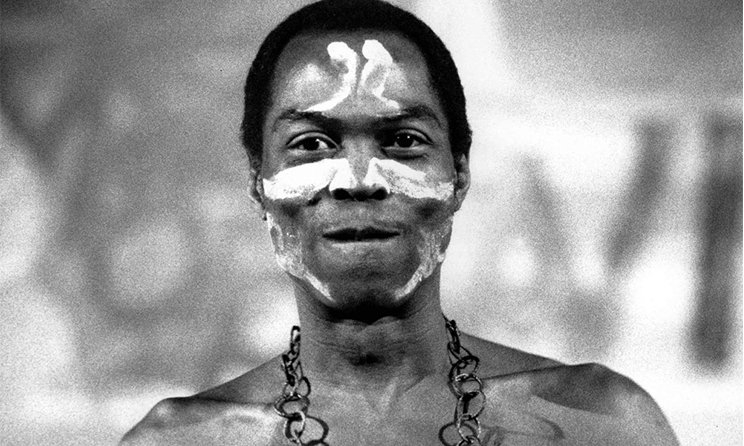
Before death, he had been nothing but sound on radio and caution from adults. For the conservative, it was important to separate his social activism from his cultural iconoclasm. They appreciated that he spoke truth to power, but disliked that he smoked marijuana, married many wives, moved about in nothing but briefs and openly carried out rituals at his shrine. The man was great, but he was also cuckoo.
Before that trip to Lagos, Fela was also a character in a book of political cartoons that contained a diptych of his image and Michael Jackson’s. MJ was surrounded by security men leading him into a concert, while Fela was accompanied by army men leading him into a Black Maria. One man resisted society’s image of what he could be and was greeted with compassion, while the other was visited with pain and derision. In Fela’s body lay the sum of the anxiety of parents who wanted good children. Abami Eda was the image of waywardness.
It isn’t hard to understand the appeal of the political substance in Fela’s music for a culture seeking artists who will “stick it to the man”. But it’s easy to forget that Fela’s body held as much revulsion for the establishment as did his words. Tectonic shifts caused by global assimilation may have redefined the cultural landscape in Nigeria to the point where Fela’s hyper-sexuality and antagonism to western religion is acceptable, but is an artist as iconoclastic going to be celebrated today?
In cultural iconoclasm, Charles Oputa, aka Charly Boy, is the closest Nigeria has ever had to Fela. Although he neither shares the Afrobeat legend’s musical genius nor has a career of activism as bold, in his inherited elitism and consistent embodiment of the kind of cultural rebellion Nigerians greet with disgust, Charly Boy is Fela’s close cousin.
In August 2017, Charly Boy led a protest against the Muhammadu-Buhari-led Nigerian government in Abuja. He was the second artist to attempt a high-profile mobilization of people in 2017. First was 2Baba, whose January 2017 protest was cancelled. Charly Boy, too, had to cancel his protests, after experiencing violence. But this was not before Nigerians had the opportunity to question his credentials like they did 2Baba’s, whose promiscuity was mocked. Ridiculing Charly Boy centred on his consistent rejection of Nigerian ‘values’ in his dressing and lifestyle.
It is safe to assume Fela’s ability to lead a political uprising will be questioned, too, if he were still alive. Nigerians cannot react positively to a Bobrisky-like figure advocating for people to reject government corruption. It may be uncharitable to compare that cross-dressing bleach-skinned internet personality to Fela—the artist, after all, mocked black women who chemically alter their colour in ‘Yellow Fever’—but we’ll have to move close to Bobrisky’s end of the spectrum of identities to understand how many reacted to Fela’s hedonistic lifestyle.
Fela’s errant personal style emphasised his political ideology. But the destiny of revolutionaries is to be absorbed by pop culture, their activism reduced to bobby pins and bumper stickers. Martin Luther King’s ‘I have a Dream’ becomes a motivational buzzword, Che Guevara’s image is branded on t-shirts. Fela, too, is now often condensed to smoking marijuana in the open, rejecting western religion, and wearing tight fitting pants.
The reduction of Abami Eda to appearance above substance has given way to the kind of comparison that followed Wizkid’s successful September 2017 concert at Royal Albert Hall London. Blasphemous as it may sound, the (flawed) logic is that if Fela wasn’t more than the pictures we see and music we hear, then Wizkid’s wide appeal is comparable to the cultural impact of the Black President.
Wizkid is becoming a cultural icon in many ways, but to compare him to Fela is to drag his planet too close to the sun that is Fela’s legacy. The extent to which Wizkid is liked will be defined by how far he stays away from the Afrobeat Legend’s abrasive personality, while leveraging the man’s name and sound as much as he can. Any closer and he risks self-destruction.
It is unfair to ask any contemporary artist to embrace Fela’s character wholesale. The world is no longer conducive for iconoclasts, and Nigeria has never been welcoming of them. This bit-part adoption of the more appealing sides to his character is the best we’ll get out of anyone.
According to Lindsay Barett, “Fela’s memory will always symbolise the spirit of truth”, but that spirit comes in the body of an iconoclast. And if the same body appears in ways that fit today’s cultural context, we will not know what to do with it till it’s gone—by death or exile. To recapture Fela’s (many) spirits is often the goal of Felabration, and this year hopes to do that by making him into a prophet. But one thing we know about prophets is that they have no honour in their homes.
The 2017 edition of Felabration is ongoing.


Most popular
Call For Applications : ACCES seeks a UK-based performer
10 Sep 2026

Top amapiano songs of 2026
16 Feb 2026

Top Afrobeats songs of 2026
19 Mar 2026

Open call: Ernst von Siemens Music Foundation 2026 funding programmes
04 Sep 2026
Open call: FAME Week Africa, Pressure Cooker Studios songwriting camp
09 Sep 2026
Open call: Goethe-Institut grants for Southern African creatives
08 Sep 2026
Open call: SAMRO Music Creation Support Fund
02 Sep 2026
Disclaimer: Music In Africa provides a platform for musicians and contributors to embed music and videos solely for promotional purposes. If any track or video embedded on this platform violates any copyrights please inform us immediately and we will take it down. Please read our Terms of Use for more.

Subscribe to our monthly Newsletter
Follow us on social media


Please log in to post a comment.